Monday, September 29, 2014

[IR] A Clockwork Banana, A Clockwork Purple

For this first quarter, three of my classmates and I read A Clockwork Orange as our independent reading book.  This book, which we categorized under the "Written during or after the 20th century" option, had intrigued all of us before this year.  

Hearing the title of this book once is surely enough to remember it for years to come, as "clockwork" and "orange" seem to be a very odd combination of words.  Of course, it is possible to read the book without needing understand exactly what the title means.  However, I feel that knowing where the author was coming from by giving the book such an odd title gives much deeper insight into the central purpose and themes of the book.  I purchased the newest American version of the book, which includes the 21st chapter that was originally removed from the American version as well as an introduction written by Anthony Burgess 20 years after the book was published.  In this introduction, Burgess explains the complications encountered when translating the book, particularly the title, into other languages for publishing.  When "A Clockwork Orange" was translated as Arancia a Orologeria or Orange Mechanique, readers would assume Burgess was referring to a machine of some sorts that was orange in color, losing the meaning Burgess was going for.  In reality, "clockwork orange" was a term used by old Londoners (the book takes place in England) to describe someone who was incredibly odd (ex: "he's as queer as a clockwork orange").  Burgess gives this term a little more depth by using it to create an image of a person (the orange, like the fruit) oozing with juice and sweetness, which I like to think of as representing the person's potential and inner goodness.  When applying "clockwork" to the orange, the fruit becomes mechanical and useless as a fruit in itself, toughening the skin of the orange and making its juices useless.  This somewhat abstract image can be perfectly applied to the actual story, in which a merciless young offender is conditioned to be "good" in the eyes of society, unable to make decisions about crime on his own.  When this orange becomes controlled by the tactics of a government with an extreme lack of toleration for crime, we are forced to question whether terrible crimes are better or worse than the very moral choice that goes into participating in or abstaining from said crimes. Now you can see where this odd title comes from and why the word choice is so vital to the book's very purpose. 

On a bit shallower level, the title does serve a necessary purpose in drawing the reader in, giving book cover artists room for creative liberty with an interesting base for inspiration.

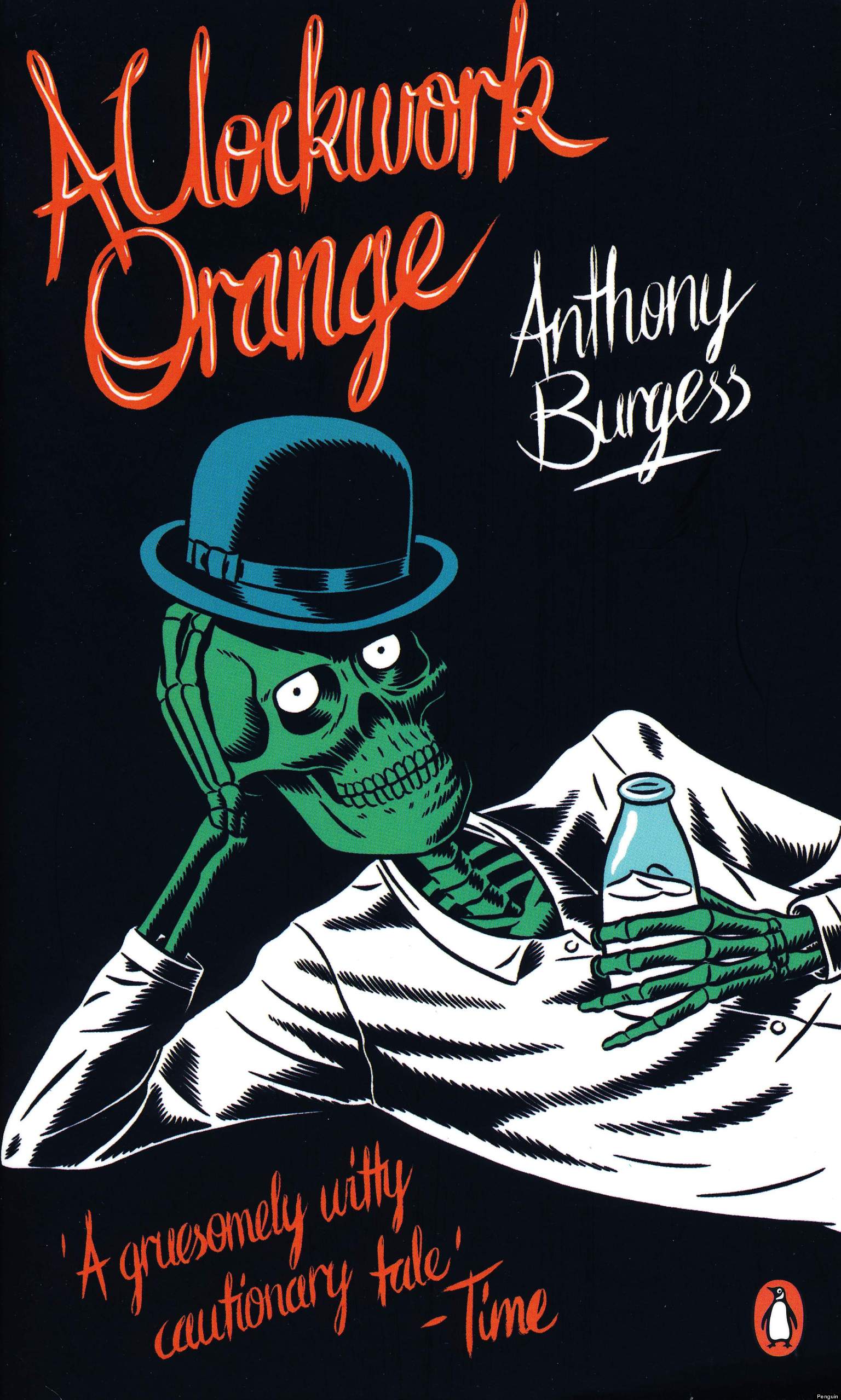
I hope an explanation of this strange title inspires you to read the book to find out more about Burgess' theory of the ethics of crime and punishment.  

Tuesday, September 9, 2014

[IR] Who Is Raising These Children?

For this first quarter, my independent reading group has decided to read A Clockwork Orange by Anthony Burgess.  I have been eager to read this book ever since my father told me that it is one of his favorite (if not his ultimate favorite) books of all time, which is strange when you consider the fact that, as a historian, my father never reads fiction (or at least never enjoys reading it).  Along with the high praises this book receives by critics and common readers alike are the intense warnings: incredibly graphic, not for the weak of stomach or of heart, will mess with your mind in so many ways.  Whilst delving into the first part of the book I fully understand why this book is practically wrapped in police line tape, as well as why it has had a cult following for fifty years. 

The whole first chapter of A Clockwork Orange follows our protagonist (?), Alex, and his "droogs" around town on their typical night of gang-fighting, raping and robbing anyone in sight.  While the main focus is on the absolutely repulsive events these young boys are taking part in, I could not stop thinking about when I would be able to get a peek into Alex's home life.  I suspected that perhaps he was homeless, but a jump to the next few chapters shows Alex climbing to his family's 10th floor apartment where he is an only child to two seemingly fine parents.  The relationship between Alex and his parents is as foggy to the reader at this point as it perhaps is for the people involved in the relationship; the parents seem to be hesitant around Alex and not quite know where they stand in terms of control over him, while Alex seems to know where he stands with them but sees no point in dwelling on the mere existence of the relationship to begin with.  There are a few points where Alex hints at maybe having done something to his parents to "teach them a lesson," which is probably what makes them so submissive to a son who is clearly up to no good when he goes out at night.  His parents appear to be blind to this side of their son, but at this point the reader can begin to assume that there are unspoken rules set by Alex about testing his limits.  

My brother, Peter, and the story's main character are the same age, which causes me to subconsciously relate the two of them.  I can assure you that my brother is not a tiny bit as horrible as Alex is, but I can see reflections in the parent-child relationships.  My brother has type 1 diabetes and my mother, especially, is incredibly anxious about how he handles it when she's not around.  He's really quite good about monitoring it and I'm sure there's nothing to worry about, but there is concern around the possibility of him partaking in drugs and alcohol at some point in his college or, god-forbid, high school career.  You might roll your eyes at this, but you have to consider the danger of my brother losing control of his wits or body in any shape or form and suddenly being unable to monitor his insulin levels.  If he passes out under the influence of something, his blood sugar could drop to the point where he dies in his sleep.  Needless to say, my mother drills this into him whenever the topic comes up and makes as many threats as she feels necessary to making her point.  On the other hand, we have Alex, who is probably receiving a lower level of discipline than my brother where he clearly needs a few dozen times more.  As a 15 year old rapist, murderer and thief, I'm seeing a slightly stronger need for some whip-cracking on the more fictional of the two teenage boys in question.  I'm hoping to learn more about what Alex has done to his parents to make them so submissive to his ways because I can't possibly imagine that they are naturally so irresponsible and cowardly. 

I am already eagerly mentally preparing myself for the second part of this book. I am so glad I decided to subject myself to this kind of mind-bending literary experience that I am sure to never forget.

Tuesday, September 2, 2014

[FW] So You Found Yourself in The Friend Zone

 Fun fact: I have a third degree black belt in crushing on guys for extended periods of time.  Average crush time: 3.5 years.  Is it because I have nothing better to do? Probably.  Is it because I pick genuinely good people to fawn over? Sure.  Is it a result of the not-too-uncommon need for young girls (and maybe boys) to seek affection and spend hours (or in my case, years) praying that there will be some sign of reciprocated affection in any form? If I'm speaking for myself, then yes.  I remember the exact moment I first felt the sweet ache that a crush creates in the bottom of your lungs.  I was rolling backwards down a steep hill in my backyard, riding shotgun in an old golf cart while I screamed at the neighbor boy to SLOW DOWN and OH MY GOD WHY DON'T YOU LISTEN TO ME.  When he replied "because it's fun to make you mad!" the feels hit me like a sack of soggy bricks.  It's always the bad boys, isn't it, ladies?  

Of course, girls aren't the only people to have crushes.  When a boy likes a girl, ONE method of seeking reciprocated attraction is to play it cool and take a keen in a girls feelings, listening to her woes, receiving her calls and texts when the guy she likes is being an ass hat, maybe bringing her a pint of the holy Ben and Jerry's when she's really down in the dumps, etc.  The boy resists the urge to make any moves that would jeopardize this friendly relationship, instead waiting for the girl to confess her feelings.  Suddenly, a turn is taken where the girl finds a boyfriend who is not the same boy who has been tending to her every need.  WHAT? HOW- HOW COULD THIS HAPPEN? Wait, bro, you put in all of that hard work and you still didn't bag the chick? Doesn't she, like, owe it to you?  Ah, see, there is the issue.  The idea that you would expect something as intimate as sex (making the grand assumption that that was the target of your comforting tactics) in return for pats on the back, listening to boring phone calls, and bringing her ice cream is a grave misinterpretation of the concept of being a decent human being.  So when you are so shocked that the girl didn't pick you as the most promising of candidates, keep in mind that the joke is on you for assuming that a girl will give you her body in return for your time.  

Two ground rules for staying out of the dreaded Friend Zone:

#1: Don't assume that you're doing a girl a favor by using deceit to lead her to think you're a good person.  You're not flattering anyone, nor are you making yourself more attractive by using this tactic.

#2: Don't waste your time "being there" for a girl when your motives are set in a different direction.  Girls would rather you NOT be a good listener/friend and be HONEST about your motives than APPEAR to be a good listener/friend and be DECEITFUL about it. 

I have found myself deep in the Friend Zone once before.  My last crush had an appreciation for great writing, an even greater appreciation for good 90s rock music, and cheeks that always made him look like he'd just walked in from a blizzard.  Needless to say, he was dreamy as heck.  When he introduced me to his girlfriend last year, I found myself following glowing traffic cones and flashing diamond-shaped signs in to the Friend Zone.  It hurt for a while, like that feeling in my lungs had leaked into my spine where the aching suddenly didn't feel so sweet anymore.  But the thing that makes my experience in the Friend Zone a little different than the boys who grieve over the fact that they never got laid despite all their wasted time was that, oh yeah, I wasn't dead-set on getting laid.  I never spent time reading Plato's Republic so that the two of us could discuss the philosophy with the mindset that it would push me towards the likelihood of getting something more than a good conversation out of it.  I never made plans to get coffee or go to a concert with the hopes that maybe we'd do something more (cough cough) afterwards.  The melancholic feeling in me was subdued when I remembered that I liked him a lot because he was the coolest guy I knew, and that didn't change simply because my chances had plummeted below sea level (even though they were 6000 miles below the surface to begin with).  People who find themselves in the Friend Zone can be victims of an unfortunate hand of cards in the relationship game, or they can be culprits of a deceitful plan to receive intimacy in return for taking an disingenuous interest in someone's feelings.  

Note: I generalized "boys" who use this tactic of getting a "girl" because I predominantly see guys complaining about being put in the Friend Zone rather than girls.  I suppose this is because relationships and sex tend to be in more distant categories for girls as opposed to guys who often group these two categories together.  In theory, girls can be culprits of these deceitful tactics, but something tells me she'd reach her target in much less time than a boy would with a girl.  Let's not forget to exclude same-sex relationships, in which these tactics could be used just as often as they can be in opposite-sex relationships.

Another Note: this idea for a blog post has been festering in my mind ever since I saw the wonderful Dylan Garity's performance of his poem "Friend Zone," which can be found on YouTube.