I knew something was fishy when I saw that "Tragedy" was identified as a type of comedy in the packet that Ms. Pyle distributed to us at the beginning of the comedy unit. I was confused as to how anything tragic could be seen as comedic until I realized that it's a bit like a parody in that it takes something serious (usually religious) and pokes fun at it. I could see where the concepts of humor and grief are able to combine and create a twisted sector of dark humor.
My knowledge and interest on this topic were furthered when we read Tom McAlindon's "What is a Shakespeare Tragedy?" The section of this chapter that stuck out to me the most by far was around the fifth page when McAlindon delves into the masterful use of comedic elements in tragic works. Shakespeare is an excellent representation of this twist on genres as he employs it rather apparently in many (if not all) of his works. McAlindon makes reference to Romeo and Juliet, which is generally identified as a tragedy. We all know the incredibly dramatic and unfortunate conclusion of the play, but the tone of the play as a whole cannot be attributed to this one scene. With a master of wordplay, innuendo and irony like Shakespeare, it is impossible to have a purely depressing work leaving his desk. This need for comedic elements goes beyond Shakespeare's personal style as well; when considering the format in which plays were presented during Shakespeare's time and who was attending the shows, it's easy to recognize the need for something chuckle-worthy going on onstage. That's not to say tragedies are boring and unable to stand on their own, but rather that occasional evocations of humor have been found to strengthen a tragedy in various ways.
I've read a decent amount of Shakespeare plays in my day and I must say that I have audibly laughed out loud at Macbeth more than any other play by him (that includes my favorite, Twelfth Night, which is a comedy). There are honestly so many sly jokes and terribly ironic remarks that just boost my belief that Shakespeare is a literary genius, especially when it comes to incorporating humor into his works. To be honest, I think all Shakespeare plays are a comedies, but some are full of raw humor (categorizing them as comedies) and others are full of dark, sheathed, deceptive jokes (categorizing them as tragedies).
McAlindon's commentary on tragedy supports this concept of humor in tragedy. He makes the argument that you cannot have a tragedy without elements of a comedy, despite the fact that they are on opposite ends of the generic spectrum. This can go both ways, especially when we see a subgenre of comedy centered around the comedic elements of a tragedy. This creates the Yin and Yang of literary genres and the presence of humor; You cannot have one without at least a touch of the other. Knowing this, reading a tragedy becomes much more interesting when you know that there is underlying humor somewhere, and your favorite comedies most definitely contain solemnity that should be recognized. This knowledge will hopefully ultimately aid in my quest to become a well-rounded literary scholar.
Tuesday, December 2, 2014

Tuesday, November 11, 2014
[IR] I Am Plath, Plath Is Me
My 2nd quarter independent reading group is reading The Bell Jar by the almighty Sylvia Plath, which fulfills the female author reading requirement.
For this blog post I will discuss the only thing running through my mind as I read this book: Sylvia Plath's main character and I have some much in common. Here is a running list of events/characteristics that apply to the main character (Esther Greenwood) of this book and myself:
For this blog post I will discuss the only thing running through my mind as I read this book: Sylvia Plath's main character and I have some much in common. Here is a running list of events/characteristics that apply to the main character (Esther Greenwood) of this book and myself:
- We both think NYC is a little overrated.
- We both enjoy writing, especially poetry.
- We feel like our academic achievements have fallen flat in comparison to their past states. While we both still do well in school, the sense of fulfillment has worn off or a slight drop in assignment scores leaves a more profound gash in the mental leather upholstery of life than it does in real life. I used to be called the "curve killer" until the last 2 years of high school punched me in the gut.
- We both feel successful in an academic setting, but feel a little beat up in the real world. Even the valedictorian is one fish in a sea of valedictorians. Also, no one's dreams are as cool when they're presented to the real world as they are on the drawing board at home (that hurts to write but it's the sad truth).
- Our dreams have both been verbally abused by respected, knowledgeable professionals in the business world.
- We both are of German decent and want to learn German really badly but never really get around to that whole "studying" thing.
- We both tend to hang around the people who we think are cool (when thrown into new situations) and end up finding ourselves incredibly bored and/or uncomfortable.
- We both love sleeping in and food (duh).
- We both have a younger brother. Her brother is incredibly successful and mine is bound to be successful in one area or another. I'm thinking endocrinology, weapon engineering or nonprofit Indian reservation work.
- We both wear a heck of a lot of black.
- We are both always the wing woman. Pro tip: be as repulsive as possible in order to make your already attractive friend appear even more attractive.
So my reading group has decided to split our perspectives up into two groups: two of us read the story as if the main character is an autobiographical representation of Plath herself, and the other two of us read the book as if Ester Greenwood is a completely detached image that Plath simply invented for the story. There is already much speculation among scholars that suggests The Bell Jar is reflective of Plath in more ways than a typical book would reflect its author. This being said, it's important to clarify one huge difference between Plath's main character and myself: I am not suffering from depression and I have never contemplated committing suicide. I don't know if I was seeking out similarities between the main character and myself (that wouldn't be too shocking considering a reader always wants to connect to the main character in a book), but I was certainly noticing a lot of them. Maybe I am trying to scare myself into thinking I'm more like Sylvia Plath than I ever want to be. I am hoping these parallels will start disappearing once Ester Greenwood begins to spiral downward into depths in which I am lucky enough to have never found myself.
Tuesday, October 28, 2014
[CC] In Defense of Crude Humor
It's only slightly sick that the majority of the things that come to my mind at the mention of "humor" are crude to the bone. I don't exactly understand why gross things an blunt presentations of topics are so hilarious. It makes sense in some respects when you consider the fact that messages that cross new paths in our brain trigger a response (usually a laugh), which is why we find ANYTHING funny in the first place. This is why old jokes stop being funny after a while-- that path in the brain has become normal. When humor is used to present a topic very bluntly, we can not only discover new content but also a new manner in which to receive content.
The Book of Mormon is a primary example of crude humor. The writers of South Park took every aspect of the Mormon religion and made fun of it primarily by contrasting it with the Ugandan culture. The entire musical is one atomic bomb of innuendo, stereotypes, gore, flamboyant homosexuality and jazzy dance numbers, all of which are somehow able to offend anyone in the audience regardless of sexual orientation, race, or religion. Many people get up and leave the show before the first act is over due to their inability to handle the crudeness of it all. I myself have seen it twice (once from the front row) and spent too much time laughing my butt off at the jokes to be too offended by any part of the performance. I can't help but dwell on the fact that the main reason the musical could be so consistently hilarious was because there was so much material to base it off of. I'm not making an attempt to denounce religion, but when you look at the concept of religion in retrospect it can be pretty funny. I'm not saying Mormons were asking for any of this, but they are a religion founded in a traceable human being who claims the ancient document known as the Bible actually took place on American soil. More than that, the religion is being upheld by a primarily white demographic in the great state of... Utah. Wait, people live in Utah? Apparently so.
The Almighty and Righteous Bo Burnham is another example of crude humor in its purest and most quality state. Without repeating my entire 5 Reasons Why Bo Burnham Is The Best Human Being Under the Age of 25 post, I'll tell you that Bo Burnham is the master of humor with a purpose. He touches on various social issues by presenting them in a traditionally humorous tone that ends up causing the audience members to reflect upon themselves. On top of that, he does about 80% of it in song! Oh heck yeah! (See example at right)
Part of the reason I appreciate crude humor so much is because it says things that need to be said without feeling the need to skirt the subject and drown it in euphemisms. The Book of Mormon points out some of the absurdities of religion that have serious negative impacts on society, such as forcing LGBT youth to stay closeted (often having serious negative impacts on mental health). The musical makes continuous references to rampant AIDS and infections in the Ugandan community where the majority of the musical takes place, which is totally offensive... or is it? Disease and infection are serious issues on the African continent, and the musical seems to be making a mockery of the fact that we do not give this fact nearly as much attention and care as it deserves. Bo Burnham wrote the song "Repeat Stuff" as a parody of, well, basically every pop song made in the last decade or two. While the song contains references to Nazi Germany, doing sexual favors for the devil, and writes off youths with handicaps, it sheds a heck of a lot of light on the cruel motives of the modern music industry. Bo acknowledged the fact that so many people are either blind or ignorant to what is behind the curtain that the only way to make it apparent was to be as blunt as possible while still being accessible through humor. I can't think of a time where crude humor had more of an effect on my than the line in Bo's song "Repeat Stuff" that said (from the perspective of a pop star):
Like, what? It hit me hard. I like that punch to the gut and the rawest (and most entertaining) way to get that punch is through crude humor.
The Book of Mormon is a primary example of crude humor. The writers of South Park took every aspect of the Mormon religion and made fun of it primarily by contrasting it with the Ugandan culture. The entire musical is one atomic bomb of innuendo, stereotypes, gore, flamboyant homosexuality and jazzy dance numbers, all of which are somehow able to offend anyone in the audience regardless of sexual orientation, race, or religion. Many people get up and leave the show before the first act is over due to their inability to handle the crudeness of it all. I myself have seen it twice (once from the front row) and spent too much time laughing my butt off at the jokes to be too offended by any part of the performance. I can't help but dwell on the fact that the main reason the musical could be so consistently hilarious was because there was so much material to base it off of. I'm not making an attempt to denounce religion, but when you look at the concept of religion in retrospect it can be pretty funny. I'm not saying Mormons were asking for any of this, but they are a religion founded in a traceable human being who claims the ancient document known as the Bible actually took place on American soil. More than that, the religion is being upheld by a primarily white demographic in the great state of... Utah. Wait, people live in Utah? Apparently so.
The Almighty and Righteous Bo Burnham is another example of crude humor in its purest and most quality state. Without repeating my entire 5 Reasons Why Bo Burnham Is The Best Human Being Under the Age of 25 post, I'll tell you that Bo Burnham is the master of humor with a purpose. He touches on various social issues by presenting them in a traditionally humorous tone that ends up causing the audience members to reflect upon themselves. On top of that, he does about 80% of it in song! Oh heck yeah! (See example at right)
Part of the reason I appreciate crude humor so much is because it says things that need to be said without feeling the need to skirt the subject and drown it in euphemisms. The Book of Mormon points out some of the absurdities of religion that have serious negative impacts on society, such as forcing LGBT youth to stay closeted (often having serious negative impacts on mental health). The musical makes continuous references to rampant AIDS and infections in the Ugandan community where the majority of the musical takes place, which is totally offensive... or is it? Disease and infection are serious issues on the African continent, and the musical seems to be making a mockery of the fact that we do not give this fact nearly as much attention and care as it deserves. Bo Burnham wrote the song "Repeat Stuff" as a parody of, well, basically every pop song made in the last decade or two. While the song contains references to Nazi Germany, doing sexual favors for the devil, and writes off youths with handicaps, it sheds a heck of a lot of light on the cruel motives of the modern music industry. Bo acknowledged the fact that so many people are either blind or ignorant to what is behind the curtain that the only way to make it apparent was to be as blunt as possible while still being accessible through humor. I can't think of a time where crude humor had more of an effect on my than the line in Bo's song "Repeat Stuff" that said (from the perspective of a pop star):
"I'm in magazines, full of model teens, so far above you. So read them and hate yourself, then pay me to tell you I love you."
Like, what? It hit me hard. I like that punch to the gut and the rawest (and most entertaining) way to get that punch is through crude humor.
Monday, October 6, 2014
[CC] On Poetry And Its General Existence
I really actually love poetry so much and I cannot believe this is the first year I've been asked to spend a decent amount of time studying it. That is, at Black River. When I was in 8th grade I was a part of the PATH program (I have no idea what PATH stands for) at Hope College, where a couple dozen middle school students are plucked from their normal classes at school and placed in college-level courses taught by incredible teachers who know how to get college-level work out of 13 year old children. Being a part of the program for two years was one of the best decisions I ever made for my academic career (even though I practically waged war on a sub-par 2nd year teacher, but that's beside the point). The poetry unit of my first year at PATH challenged me, but I don't think I challenged me, you know? I wasn't pushing myself to write quality stuff and I didn't give myself enough time to roll things over in my mind before trying to get them down on paper. My poems were somewhat crappy, looking back on them, but I learned that putting words into a rhyming scheme based on a simple theme is not enough. It's easy enough, but without any sense of satisfaction, it doesn't feel like poetry at all.
This is why I really wish we had the opportunity to write poetry in AP Lit. In applying the things we are learning about figurative language to our own ideas, we could better understand the poems we are closely observing and hopefully better appreciate the work that went into writing them.
IN THE WORLD OF POETRY I am a big fan of three things:
#1: Slam poetry
#2: Spurts of inspiration that find themselves in notes on my phone
#3: Sonnets
I think the slam poetry thing is pretty self-explanatory, to be honest. People who don't like slam poetry are either lacking a soul or have never seen "Ursula" by William Giles, "OCD" by Neil Hilborn, "Poem for Guys Who Spit After Smoking Cigarettes Between Slicing Pizzas" by Harlan Kelly, and, of course, "Shrinking Women" by Lily Myers.
Do you ever get these little phrases or pairs of words that sound SO FREAKING GOOD in your head that you have to write them down? I definitely have that every once and a while and I cherish those moments like I cherish new Julian Casablancas songs and Choxie chocolate bars. They might sound like crap when you actually say them out loud or even see them on paper, but it feels good to feel creative in the moments where you can go back to those little phrases and say "dang, that was a good line, Hannah."
When I'm not creative or inspired enough on my own but feel like writing poetry, sonnets will usually do the trick. I find that the structure squeezes ideas in just the right way to at least make them SEEM more profound. I just dug up my collection of poems that I wrote as a 13 year old in PATH; since this blog post is scattered and probably very very boring, I will put my pride and reputation in a vulnerable spot for entertainment purposes. Here's the first sonnet I ever wrote:
There is nothing so glorious as sleep.
From my bed into another world I manage to float.
I push away from the dock, tying spider web ropes to the bow of the boat,
Out to sea, into the ocean-- green, wide and deep.
And with no fear, I run and leap
Into an abyss, breaking through a paper thin coat
Of struggle, triggering the lowering of a bridge athwart a moat.
This sense of rest forces me to sit and weep,
And I've learned that nothing comes from risks you don't take.
Through the journey of sleep, my honor and bravery is tried,
Every moment spent not regretting is enjoyed.
With each minute I sleep, a thin stick of dynamite is deployed,
But the lighter is my joy, and now would be fine if I died.
I drift in paradise, where I will remain 'til I wake.
Clearly I was a fan of sleeping. It's good to see that not much has changed.
This is why I really wish we had the opportunity to write poetry in AP Lit. In applying the things we are learning about figurative language to our own ideas, we could better understand the poems we are closely observing and hopefully better appreciate the work that went into writing them.
IN THE WORLD OF POETRY I am a big fan of three things:
#1: Slam poetry
#2: Spurts of inspiration that find themselves in notes on my phone
#3: Sonnets
I think the slam poetry thing is pretty self-explanatory, to be honest. People who don't like slam poetry are either lacking a soul or have never seen "Ursula" by William Giles, "OCD" by Neil Hilborn, "Poem for Guys Who Spit After Smoking Cigarettes Between Slicing Pizzas" by Harlan Kelly, and, of course, "Shrinking Women" by Lily Myers.
Do you ever get these little phrases or pairs of words that sound SO FREAKING GOOD in your head that you have to write them down? I definitely have that every once and a while and I cherish those moments like I cherish new Julian Casablancas songs and Choxie chocolate bars. They might sound like crap when you actually say them out loud or even see them on paper, but it feels good to feel creative in the moments where you can go back to those little phrases and say "dang, that was a good line, Hannah."
When I'm not creative or inspired enough on my own but feel like writing poetry, sonnets will usually do the trick. I find that the structure squeezes ideas in just the right way to at least make them SEEM more profound. I just dug up my collection of poems that I wrote as a 13 year old in PATH; since this blog post is scattered and probably very very boring, I will put my pride and reputation in a vulnerable spot for entertainment purposes. Here's the first sonnet I ever wrote:
There is nothing so glorious as sleep.
From my bed into another world I manage to float.
I push away from the dock, tying spider web ropes to the bow of the boat,
Out to sea, into the ocean-- green, wide and deep.
And with no fear, I run and leap
Into an abyss, breaking through a paper thin coat
Of struggle, triggering the lowering of a bridge athwart a moat.
This sense of rest forces me to sit and weep,
And I've learned that nothing comes from risks you don't take.
Through the journey of sleep, my honor and bravery is tried,
Every moment spent not regretting is enjoyed.
With each minute I sleep, a thin stick of dynamite is deployed,
But the lighter is my joy, and now would be fine if I died.
I drift in paradise, where I will remain 'til I wake.
Clearly I was a fan of sleeping. It's good to see that not much has changed.
Monday, September 29, 2014
[IR] A Clockwork Banana, A Clockwork Purple
For this first quarter, three of my classmates and I read A Clockwork Orange as our independent reading book. This book, which we categorized under the "Written during or after the 20th century" option, had intrigued all of us before this year.
Hearing the title of this book once is surely enough to remember it for years to come, as "clockwork" and "orange" seem to be a very odd combination of words. Of course, it is possible to read the book without needing understand exactly what the title means. However, I feel that knowing where the author was coming from by giving the book such an odd title gives much deeper insight into the central purpose and themes of the book. I purchased the newest American version of the book, which includes the 21st chapter that was originally removed from the American version as well as an introduction written by Anthony Burgess 20 years after the book was published. In this introduction, Burgess explains the complications encountered when translating the book, particularly the title, into other languages for publishing. When "A Clockwork Orange" was translated as Arancia a Orologeria or Orange Mechanique, readers would assume Burgess was referring to a machine of some sorts that was orange in color, losing the meaning Burgess was going for. In reality, "clockwork orange" was a term used by old Londoners (the book takes place in England) to describe someone who was incredibly odd (ex: "he's as queer as a clockwork orange"). Burgess gives this term a little more depth by using it to create an image of a person (the orange, like the fruit) oozing with juice and sweetness, which I like to think of as representing the person's potential and inner goodness. When applying "clockwork" to the orange, the fruit becomes mechanical and useless as a fruit in itself, toughening the skin of the orange and making its juices useless. This somewhat abstract image can be perfectly applied to the actual story, in which a merciless young offender is conditioned to be "good" in the eyes of society, unable to make decisions about crime on his own. When this orange becomes controlled by the tactics of a government with an extreme lack of toleration for crime, we are forced to question whether terrible crimes are better or worse than the very moral choice that goes into participating in or abstaining from said crimes. Now you can see where this odd title comes from and why the word choice is so vital to the book's very purpose.
On a bit shallower level, the title does serve a necessary purpose in drawing the reader in, giving book cover artists room for creative liberty with an interesting base for inspiration.

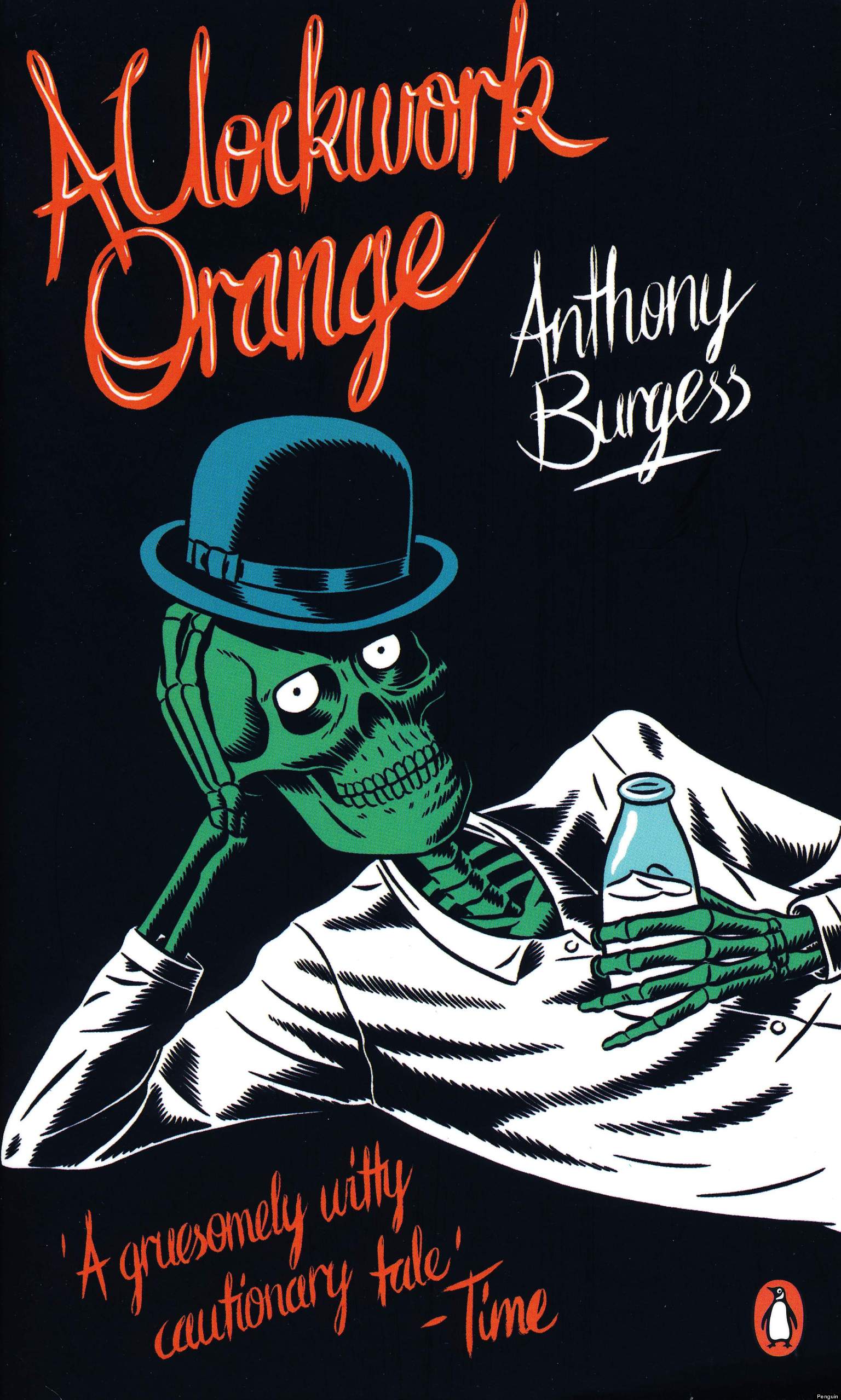

Hearing the title of this book once is surely enough to remember it for years to come, as "clockwork" and "orange" seem to be a very odd combination of words. Of course, it is possible to read the book without needing understand exactly what the title means. However, I feel that knowing where the author was coming from by giving the book such an odd title gives much deeper insight into the central purpose and themes of the book. I purchased the newest American version of the book, which includes the 21st chapter that was originally removed from the American version as well as an introduction written by Anthony Burgess 20 years after the book was published. In this introduction, Burgess explains the complications encountered when translating the book, particularly the title, into other languages for publishing. When "A Clockwork Orange" was translated as Arancia a Orologeria or Orange Mechanique, readers would assume Burgess was referring to a machine of some sorts that was orange in color, losing the meaning Burgess was going for. In reality, "clockwork orange" was a term used by old Londoners (the book takes place in England) to describe someone who was incredibly odd (ex: "he's as queer as a clockwork orange"). Burgess gives this term a little more depth by using it to create an image of a person (the orange, like the fruit) oozing with juice and sweetness, which I like to think of as representing the person's potential and inner goodness. When applying "clockwork" to the orange, the fruit becomes mechanical and useless as a fruit in itself, toughening the skin of the orange and making its juices useless. This somewhat abstract image can be perfectly applied to the actual story, in which a merciless young offender is conditioned to be "good" in the eyes of society, unable to make decisions about crime on his own. When this orange becomes controlled by the tactics of a government with an extreme lack of toleration for crime, we are forced to question whether terrible crimes are better or worse than the very moral choice that goes into participating in or abstaining from said crimes. Now you can see where this odd title comes from and why the word choice is so vital to the book's very purpose.
On a bit shallower level, the title does serve a necessary purpose in drawing the reader in, giving book cover artists room for creative liberty with an interesting base for inspiration.
I hope an explanation of this strange title inspires you to read the book to find out more about Burgess' theory of the ethics of crime and punishment.
Tuesday, September 9, 2014
[IR] Who Is Raising These Children?
For this first quarter, my independent reading group has decided to read A Clockwork Orange by Anthony Burgess. I have been eager to read this book ever since my father told me that it is one of his favorite (if not his ultimate favorite) books of all time, which is strange when you consider the fact that, as a historian, my father never reads fiction (or at least never enjoys reading it). Along with the high praises this book receives by critics and common readers alike are the intense warnings: incredibly graphic, not for the weak of stomach or of heart, will mess with your mind in so many ways. Whilst delving into the first part of the book I fully understand why this book is practically wrapped in police line tape, as well as why it has had a cult following for fifty years.
The whole first chapter of A Clockwork Orange follows our protagonist (?), Alex, and his "droogs" around town on their typical night of gang-fighting, raping and robbing anyone in sight. While the main focus is on the absolutely repulsive events these young boys are taking part in, I could not stop thinking about when I would be able to get a peek into Alex's home life. I suspected that perhaps he was homeless, but a jump to the next few chapters shows Alex climbing to his family's 10th floor apartment where he is an only child to two seemingly fine parents. The relationship between Alex and his parents is as foggy to the reader at this point as it perhaps is for the people involved in the relationship; the parents seem to be hesitant around Alex and not quite know where they stand in terms of control over him, while Alex seems to know where he stands with them but sees no point in dwelling on the mere existence of the relationship to begin with. There are a few points where Alex hints at maybe having done something to his parents to "teach them a lesson," which is probably what makes them so submissive to a son who is clearly up to no good when he goes out at night. His parents appear to be blind to this side of their son, but at this point the reader can begin to assume that there are unspoken rules set by Alex about testing his limits.
My brother, Peter, and the story's main character are the same age, which causes me to subconsciously relate the two of them. I can assure you that my brother is not a tiny bit as horrible as Alex is, but I can see reflections in the parent-child relationships. My brother has type 1 diabetes and my mother, especially, is incredibly anxious about how he handles it when she's not around. He's really quite good about monitoring it and I'm sure there's nothing to worry about, but there is concern around the possibility of him partaking in drugs and alcohol at some point in his college or, god-forbid, high school career. You might roll your eyes at this, but you have to consider the danger of my brother losing control of his wits or body in any shape or form and suddenly being unable to monitor his insulin levels. If he passes out under the influence of something, his blood sugar could drop to the point where he dies in his sleep. Needless to say, my mother drills this into him whenever the topic comes up and makes as many threats as she feels necessary to making her point. On the other hand, we have Alex, who is probably receiving a lower level of discipline than my brother where he clearly needs a few dozen times more. As a 15 year old rapist, murderer and thief, I'm seeing a slightly stronger need for some whip-cracking on the more fictional of the two teenage boys in question. I'm hoping to learn more about what Alex has done to his parents to make them so submissive to his ways because I can't possibly imagine that they are naturally so irresponsible and cowardly.
I am already eagerly mentally preparing myself for the second part of this book. I am so glad I decided to subject myself to this kind of mind-bending literary experience that I am sure to never forget.
The whole first chapter of A Clockwork Orange follows our protagonist (?), Alex, and his "droogs" around town on their typical night of gang-fighting, raping and robbing anyone in sight. While the main focus is on the absolutely repulsive events these young boys are taking part in, I could not stop thinking about when I would be able to get a peek into Alex's home life. I suspected that perhaps he was homeless, but a jump to the next few chapters shows Alex climbing to his family's 10th floor apartment where he is an only child to two seemingly fine parents. The relationship between Alex and his parents is as foggy to the reader at this point as it perhaps is for the people involved in the relationship; the parents seem to be hesitant around Alex and not quite know where they stand in terms of control over him, while Alex seems to know where he stands with them but sees no point in dwelling on the mere existence of the relationship to begin with. There are a few points where Alex hints at maybe having done something to his parents to "teach them a lesson," which is probably what makes them so submissive to a son who is clearly up to no good when he goes out at night. His parents appear to be blind to this side of their son, but at this point the reader can begin to assume that there are unspoken rules set by Alex about testing his limits.
My brother, Peter, and the story's main character are the same age, which causes me to subconsciously relate the two of them. I can assure you that my brother is not a tiny bit as horrible as Alex is, but I can see reflections in the parent-child relationships. My brother has type 1 diabetes and my mother, especially, is incredibly anxious about how he handles it when she's not around. He's really quite good about monitoring it and I'm sure there's nothing to worry about, but there is concern around the possibility of him partaking in drugs and alcohol at some point in his college or, god-forbid, high school career. You might roll your eyes at this, but you have to consider the danger of my brother losing control of his wits or body in any shape or form and suddenly being unable to monitor his insulin levels. If he passes out under the influence of something, his blood sugar could drop to the point where he dies in his sleep. Needless to say, my mother drills this into him whenever the topic comes up and makes as many threats as she feels necessary to making her point. On the other hand, we have Alex, who is probably receiving a lower level of discipline than my brother where he clearly needs a few dozen times more. As a 15 year old rapist, murderer and thief, I'm seeing a slightly stronger need for some whip-cracking on the more fictional of the two teenage boys in question. I'm hoping to learn more about what Alex has done to his parents to make them so submissive to his ways because I can't possibly imagine that they are naturally so irresponsible and cowardly.
I am already eagerly mentally preparing myself for the second part of this book. I am so glad I decided to subject myself to this kind of mind-bending literary experience that I am sure to never forget.
Tuesday, September 2, 2014
[FW] So You Found Yourself in The Friend Zone
Fun fact: I have a third degree black belt in crushing on guys for extended periods of time. Average crush time: 3.5 years. Is it because I have nothing better to do? Probably. Is it because I pick genuinely good people to fawn over? Sure. Is it a result of the not-too-uncommon need for young girls (and maybe boys) to seek affection and spend hours (or in my case, years) praying that there will be some sign of reciprocated affection in any form? If I'm speaking for myself, then yes. I remember the exact moment I first felt the sweet ache that a crush creates in the bottom of your lungs. I was rolling backwards down a steep hill in my backyard, riding shotgun in an old golf cart while I screamed at the neighbor boy to SLOW DOWN and OH MY GOD WHY DON'T YOU LISTEN TO ME. When he replied "because it's fun to make you mad!" the feels hit me like a sack of soggy bricks. It's always the bad boys, isn't it, ladies?
Of course, girls aren't the only people to have crushes. When a boy likes a girl, ONE method of seeking reciprocated attraction is to play it cool and take a keen in a girls feelings, listening to her woes, receiving her calls and texts when the guy she likes is being an ass hat, maybe bringing her a pint of the holy Ben and Jerry's when she's really down in the dumps, etc. The boy resists the urge to make any moves that would jeopardize this friendly relationship, instead waiting for the girl to confess her feelings. Suddenly, a turn is taken where the girl finds a boyfriend who is not the same boy who has been tending to her every need. WHAT? HOW- HOW COULD THIS HAPPEN? Wait, bro, you put in all of that hard work and you still didn't bag the chick? Doesn't she, like, owe it to you? Ah, see, there is the issue. The idea that you would expect something as intimate as sex (making the grand assumption that that was the target of your comforting tactics) in return for pats on the back, listening to boring phone calls, and bringing her ice cream is a grave misinterpretation of the concept of being a decent human being. So when you are so shocked that the girl didn't pick you as the most promising of candidates, keep in mind that the joke is on you for assuming that a girl will give you her body in return for your time.
Two ground rules for staying out of the dreaded Friend Zone:
#1: Don't assume that you're doing a girl a favor by using deceit to lead her to think you're a good person. You're not flattering anyone, nor are you making yourself more attractive by using this tactic.
#2: Don't waste your time "being there" for a girl when your motives are set in a different direction. Girls would rather you NOT be a good listener/friend and be HONEST about your motives than APPEAR to be a good listener/friend and be DECEITFUL about it.
I have found myself deep in the Friend Zone once before. My last crush had an appreciation for great writing, an even greater appreciation for good 90s rock music, and cheeks that always made him look like he'd just walked in from a blizzard. Needless to say, he was dreamy as heck. When he introduced me to his girlfriend last year, I found myself following glowing traffic cones and flashing diamond-shaped signs in to the Friend Zone. It hurt for a while, like that feeling in my lungs had leaked into my spine where the aching suddenly didn't feel so sweet anymore. But the thing that makes my experience in the Friend Zone a little different than the boys who grieve over the fact that they never got laid despite all their wasted time was that, oh yeah, I wasn't dead-set on getting laid. I never spent time reading Plato's Republic so that the two of us could discuss the philosophy with the mindset that it would push me towards the likelihood of getting something more than a good conversation out of it. I never made plans to get coffee or go to a concert with the hopes that maybe we'd do something more (cough cough) afterwards. The melancholic feeling in me was subdued when I remembered that I liked him a lot because he was the coolest guy I knew, and that didn't change simply because my chances had plummeted below sea level (even though they were 6000 miles below the surface to begin with). People who find themselves in the Friend Zone can be victims of an unfortunate hand of cards in the relationship game, or they can be culprits of a deceitful plan to receive intimacy in return for taking an disingenuous interest in someone's feelings.
Note: I generalized "boys" who use this tactic of getting a "girl" because I predominantly see guys complaining about being put in the Friend Zone rather than girls. I suppose this is because relationships and sex tend to be in more distant categories for girls as opposed to guys who often group these two categories together. In theory, girls can be culprits of these deceitful tactics, but something tells me she'd reach her target in much less time than a boy would with a girl. Let's not forget to exclude same-sex relationships, in which these tactics could be used just as often as they can be in opposite-sex relationships.
Another Note: this idea for a blog post has been festering in my mind ever since I saw the wonderful Dylan Garity's performance of his poem "Friend Zone," which can be found on YouTube.
Of course, girls aren't the only people to have crushes. When a boy likes a girl, ONE method of seeking reciprocated attraction is to play it cool and take a keen in a girls feelings, listening to her woes, receiving her calls and texts when the guy she likes is being an ass hat, maybe bringing her a pint of the holy Ben and Jerry's when she's really down in the dumps, etc. The boy resists the urge to make any moves that would jeopardize this friendly relationship, instead waiting for the girl to confess her feelings. Suddenly, a turn is taken where the girl finds a boyfriend who is not the same boy who has been tending to her every need. WHAT? HOW- HOW COULD THIS HAPPEN? Wait, bro, you put in all of that hard work and you still didn't bag the chick? Doesn't she, like, owe it to you? Ah, see, there is the issue. The idea that you would expect something as intimate as sex (making the grand assumption that that was the target of your comforting tactics) in return for pats on the back, listening to boring phone calls, and bringing her ice cream is a grave misinterpretation of the concept of being a decent human being. So when you are so shocked that the girl didn't pick you as the most promising of candidates, keep in mind that the joke is on you for assuming that a girl will give you her body in return for your time.
Two ground rules for staying out of the dreaded Friend Zone:
#1: Don't assume that you're doing a girl a favor by using deceit to lead her to think you're a good person. You're not flattering anyone, nor are you making yourself more attractive by using this tactic.
#2: Don't waste your time "being there" for a girl when your motives are set in a different direction. Girls would rather you NOT be a good listener/friend and be HONEST about your motives than APPEAR to be a good listener/friend and be DECEITFUL about it.
I have found myself deep in the Friend Zone once before. My last crush had an appreciation for great writing, an even greater appreciation for good 90s rock music, and cheeks that always made him look like he'd just walked in from a blizzard. Needless to say, he was dreamy as heck. When he introduced me to his girlfriend last year, I found myself following glowing traffic cones and flashing diamond-shaped signs in to the Friend Zone. It hurt for a while, like that feeling in my lungs had leaked into my spine where the aching suddenly didn't feel so sweet anymore. But the thing that makes my experience in the Friend Zone a little different than the boys who grieve over the fact that they never got laid despite all their wasted time was that, oh yeah, I wasn't dead-set on getting laid. I never spent time reading Plato's Republic so that the two of us could discuss the philosophy with the mindset that it would push me towards the likelihood of getting something more than a good conversation out of it. I never made plans to get coffee or go to a concert with the hopes that maybe we'd do something more (cough cough) afterwards. The melancholic feeling in me was subdued when I remembered that I liked him a lot because he was the coolest guy I knew, and that didn't change simply because my chances had plummeted below sea level (even though they were 6000 miles below the surface to begin with). People who find themselves in the Friend Zone can be victims of an unfortunate hand of cards in the relationship game, or they can be culprits of a deceitful plan to receive intimacy in return for taking an disingenuous interest in someone's feelings.
Note: I generalized "boys" who use this tactic of getting a "girl" because I predominantly see guys complaining about being put in the Friend Zone rather than girls. I suppose this is because relationships and sex tend to be in more distant categories for girls as opposed to guys who often group these two categories together. In theory, girls can be culprits of these deceitful tactics, but something tells me she'd reach her target in much less time than a boy would with a girl. Let's not forget to exclude same-sex relationships, in which these tactics could be used just as often as they can be in opposite-sex relationships.
Another Note: this idea for a blog post has been festering in my mind ever since I saw the wonderful Dylan Garity's performance of his poem "Friend Zone," which can be found on YouTube.
Saturday, July 19, 2014
Dodging Dickens, Pushing Pratchett
I've said it before and I'll say it again: Oliver Twist is one of my favorite stories of all time. I feel so lucky to have been given the opportunity to read such a highly acclaimed classic for my AP Literature class that I have put off for far too long. To have an obsession with everything Oliver Twist and not to have read the original book felt blasphemous, so a decent amount of weight has been lifted off of my shoulders. One of my favorite aspects of the story of Oliver Twist is my favorite character, Jack Dawkins (better known as "The Artful Dodger"). He's charming, he's clever, he cares for his really close friends and those who take care of him, and he is a boy with the mind and clothing of a man. This is going to sound so incredibly stupid, but I'm pretty sure Dodger was the inventor of what we call "swag" today; he knew that it was all in the attitude. One of the many reasons I immediately chose to read Oliver Twist for this summer assignment was because it's newer counterpart is a young adult fiction (my favorite genre ever ever ever) is focused entirely around The Artful Dodger. I knew this almost instantly, considering the title of this recently-published book is titled Dodger. Dodger was written by Sir Terry Pratchett, who was knighted in England for his "services to literature;" if that's not fancy, I don't know what is. Even though the time gap between the original and the "remake" in this instance is much larger than almost every other paired option on the list of books to choose from for this assignment (aside from the Book of Genesis and East of Eden), I am very confident in my ability to study YAF and old English language and I was excited to challenge myself to connect such different styles of writing.
The questions that I am encouraged to consider in the syllabus for this blog post are really fantastic questions that will get my interpretations across well, so I am going to position them below in an almost interview format.
"How does the retelling establish its own story line or stray from the original?"
It is clear to anyone who knows the story of Oliver Twist that Dodger takes root in the original Oliver Twist. While some stories that are intentionally based off of past works (especially in the case of Shakespeare) whose roots can be somewhat concealed by significant shifts in setting or genders, Terry Pratchett is actually using the popularity and merit of Dickens' Oliver Twist to give his book greater historical context and perhaps garner more interest in a quasi-sequel to Oliver's original story. The greatest difference is that this retelling focuses on The Artful Dodger almost exclusively, who was more of a supporting role in the original Oliver Twist.
"How does the retelling change your perception of the original?"
One of the coolest things about Dodger is that Charles Dickens (the author of Oliver Twist) is a character in Dodger. His presence in this newer book made me imagine Dickens as a person more than I had when I was reading Oliver Twist. When I read Dickens' history of him being thrown into the harsh conditions of the industrial movement and his family being sent to debtor's prison when Charles was only twelve years old, I imagined him growing up to be very bitter, perhaps drawing the energy to write a book like Oliver Twist from his spitefulness and strong opinions on social issues. I don't know if anyone is sure what Dickens was really like, personality-wise, but Pratchett makes him out to be a very caring, very clever man that uses his success to help anyone he can. I like this more cheerful and philanthropic image of Dickens better than an angry man grumbling away at a typewriter, which in turn influenced my sense of the overall attitude of Oliver Twist.
"Does the retelling have literary merit or is it purely entertainment?"
Considering the fact that Pratchett was knighted for his literary contributions to the world, I would say his works have already garnered a great deal of merit. Even if it was written for young adults, I can see it inspiring younger people to explore 19th century literature (especially from England) by showing how lively that era actually was. I don't see Dodger going down in history as a classic by any means, but it was well written for the most part and has a lot of potential to casual push the envelope for young readers and older readers who are experienced in classic literature.
"Which book did you appreciate more?"
 It is so, so hard to retell a story as openly as Pratchett does and not give loads of credit to the original. I am over the moon about the fact that there is an entire book dedicated to the brilliant boy known around London as "The Artful Dodger," and that Pratchett seems to know how to make a teenager feel like they're an important part of a big inside joke, but you can't beat Dickens. Let's be real here, folks. No matter how much you might love Dodger, you have to remind yourself that there would be no Dodger without Oliver Twist. Of course, there would be no Oliver Twist without the influence of past events and stories, following Foster's idea that there is only one story. But I think there's something to be said for books that are written from an intense passion for a topic that the rest of the world has been hesitant to touch, which Dickens executed so brilliantly. While they may be more convoluted and outdated, Dickens' works are just a joy to read and I owe him so much for creating a story that I have latched onto since a young age and loved ceaselessly ever since. You just can't beat him.
I am incredibly satisfied by my summer mission to tackle the old and the new versions of Dickens' great tale of Oliver Twist, and I really hope that I will have something valuable to contribute to class discussions surrounding the topic of classics versus retellings. I look forward to comparing these wonderful stories I've read with the various books read by everyone else in the class. It's sure to be a fun and enlightening year, so GET PUMMPPPEDDD.
The questions that I am encouraged to consider in the syllabus for this blog post are really fantastic questions that will get my interpretations across well, so I am going to position them below in an almost interview format.
"How does the retelling establish its own story line or stray from the original?"
It is clear to anyone who knows the story of Oliver Twist that Dodger takes root in the original Oliver Twist. While some stories that are intentionally based off of past works (especially in the case of Shakespeare) whose roots can be somewhat concealed by significant shifts in setting or genders, Terry Pratchett is actually using the popularity and merit of Dickens' Oliver Twist to give his book greater historical context and perhaps garner more interest in a quasi-sequel to Oliver's original story. The greatest difference is that this retelling focuses on The Artful Dodger almost exclusively, who was more of a supporting role in the original Oliver Twist.
"How does the retelling change your perception of the original?"
One of the coolest things about Dodger is that Charles Dickens (the author of Oliver Twist) is a character in Dodger. His presence in this newer book made me imagine Dickens as a person more than I had when I was reading Oliver Twist. When I read Dickens' history of him being thrown into the harsh conditions of the industrial movement and his family being sent to debtor's prison when Charles was only twelve years old, I imagined him growing up to be very bitter, perhaps drawing the energy to write a book like Oliver Twist from his spitefulness and strong opinions on social issues. I don't know if anyone is sure what Dickens was really like, personality-wise, but Pratchett makes him out to be a very caring, very clever man that uses his success to help anyone he can. I like this more cheerful and philanthropic image of Dickens better than an angry man grumbling away at a typewriter, which in turn influenced my sense of the overall attitude of Oliver Twist.
"Does the retelling have literary merit or is it purely entertainment?"
Considering the fact that Pratchett was knighted for his literary contributions to the world, I would say his works have already garnered a great deal of merit. Even if it was written for young adults, I can see it inspiring younger people to explore 19th century literature (especially from England) by showing how lively that era actually was. I don't see Dodger going down in history as a classic by any means, but it was well written for the most part and has a lot of potential to casual push the envelope for young readers and older readers who are experienced in classic literature.
"Which book did you appreciate more?"
It is so, so hard to retell a story as openly as Pratchett does and not give loads of credit to the original. I am over the moon about the fact that there is an entire book dedicated to the brilliant boy known around London as "The Artful Dodger," and that Pratchett seems to know how to make a teenager feel like they're an important part of a big inside joke, but you can't beat Dickens. Let's be real here, folks. No matter how much you might love Dodger, you have to remind yourself that there would be no Dodger without Oliver Twist. Of course, there would be no Oliver Twist without the influence of past events and stories, following Foster's idea that there is only one story. But I think there's something to be said for books that are written from an intense passion for a topic that the rest of the world has been hesitant to touch, which Dickens executed so brilliantly. While they may be more convoluted and outdated, Dickens' works are just a joy to read and I owe him so much for creating a story that I have latched onto since a young age and loved ceaselessly ever since. You just can't beat him.I am incredibly satisfied by my summer mission to tackle the old and the new versions of Dickens' great tale of Oliver Twist, and I really hope that I will have something valuable to contribute to class discussions surrounding the topic of classics versus retellings. I look forward to comparing these wonderful stories I've read with the various books read by everyone else in the class. It's sure to be a fun and enlightening year, so GET PUMMPPPEDDD.
Friday, July 18, 2014
Kick the Kid and the Canine
I know one thing, and it's that Dickens was not shy about incorporating violence into his stories. To be honest I'd be a little less shocked at all of the bludgeoning going on in Oliver Twist if the story hadn't been originally published in a newspaper that was commonly read aloud by families at the breakfast table. Way to keep it PG, mister Dickens.
Anyway, beatings are a significant part of Oliver's story. We see right from the beginning that Oliver is being beaten by virtually every adult of whom he is put into the care, whether it be the woman who has raised him until his tenth birthday or the mighty Beadle himself. Even the young teenage assistant to Mr. Sowerberry (the undertaker of Oliver's hometown), Noah Claypole, takes the liberty of taunting Oliver about his dead mother and beating him to bits when Oliver retaliates. We think we've seen the worst of the violence finished once Oliver runs away from the undertaker, but we are solemnly mistaken. Bill Sikes seems to bring new meaning to violence. I imagine the mere look on his face and the tone of his voice to feel incredibly threatening, and threatening he is. The greatest amount of violence we see Sikes inflict is on his poor dog, Bullseye, whose hide is frequented with blows from a stick or a fist. The dog is described to have gashes on his snout when he first enters the story, and Sikes is not shy about kicking him about. While the dog is very poorly treated, it is clear that Bullseye is incredibly protective and loyal to his master, no matter the abuse. He never runs away from Sikes, lies down in the corner at all times and responds to Sikes' orders to attack others when necessary. An interesting parallel that I drew whilst considering the topic of violence is the one between Bullseye the dog and Nancy. Nancy alludes to the fact that she worked as a thief for Fagin when she was Oliver's age and still sticks around the group. It seems that Nancy and Bill Sikes are in a romantic relationship. Like Bullseye, we see that Nancy is incredibly loyal to Sikes and usually quiet, though she is quite sassy when she speaks out. While Sikes is usually only verbally abusive to Nancy when he is taking his anger out on her, he eventually ends up beating her to death.
Anyway, beatings are a significant part of Oliver's story. We see right from the beginning that Oliver is being beaten by virtually every adult of whom he is put into the care, whether it be the woman who has raised him until his tenth birthday or the mighty Beadle himself. Even the young teenage assistant to Mr. Sowerberry (the undertaker of Oliver's hometown), Noah Claypole, takes the liberty of taunting Oliver about his dead mother and beating him to bits when Oliver retaliates. We think we've seen the worst of the violence finished once Oliver runs away from the undertaker, but we are solemnly mistaken. Bill Sikes seems to bring new meaning to violence. I imagine the mere look on his face and the tone of his voice to feel incredibly threatening, and threatening he is. The greatest amount of violence we see Sikes inflict is on his poor dog, Bullseye, whose hide is frequented with blows from a stick or a fist. The dog is described to have gashes on his snout when he first enters the story, and Sikes is not shy about kicking him about. While the dog is very poorly treated, it is clear that Bullseye is incredibly protective and loyal to his master, no matter the abuse. He never runs away from Sikes, lies down in the corner at all times and responds to Sikes' orders to attack others when necessary. An interesting parallel that I drew whilst considering the topic of violence is the one between Bullseye the dog and Nancy. Nancy alludes to the fact that she worked as a thief for Fagin when she was Oliver's age and still sticks around the group. It seems that Nancy and Bill Sikes are in a romantic relationship. Like Bullseye, we see that Nancy is incredibly loyal to Sikes and usually quiet, though she is quite sassy when she speaks out. While Sikes is usually only verbally abusive to Nancy when he is taking his anger out on her, he eventually ends up beating her to death.
In How to Read Literature Like a Professor, Foster says that one of the two types of violence in literature is the type that is used to drive plot progression. I would argue that in the case of Oliver Twist, the majority of the violence is used simply to build up the pain of Oliver's story (because it happens so darn frequently), and the small portion that is actually a major event in the story is used as plot conclusion rather than progression. But, you know, Dickens does things differently.
In the other type of violence mentioned in How to Read Literature Like a Professor, Foster mentions starvation as a form of violence. This seemed strange to me until I realized that it is being inflicted by someone or something and it is causing physical harm to someone. The perpetrator of starvation may be different depending on the scenario; for example, a person finding themselves stranded on a desert island is receiving that violence from nature. Someone with anorexia is receiving abuse from themself or, rather, their own mind. In Oliver Twist, that violence is being inflicted by the upper and middle class of England, or so Dickens wants to make the reader think. The pressure being shoveled on the poor people to become self-dependent and less of an overall bother forces every man, woman and child in 19th century workhouses to labor and starve to their eventual death. The negative stigma against the poor that was held by anyone who could keep themself out of a workhouse made these conditions worse and worse. Seeing the pain and deaths that these places caused the lower class make it difficult to deny that starvation is a form of violence.
The various ways that violence is presented in Oliver Twist taught me a lot about symbolism through abuse and somewhat hidden forms of violence that bring deeper meaning to the story as a whole.
The various ways that violence is presented in Oliver Twist taught me a lot about symbolism through abuse and somewhat hidden forms of violence that bring deeper meaning to the story as a whole.
Wednesday, July 16, 2014
London - 70 Miles
Oliver Twist has spent his entire live enslaved in poverty, but his liberation from the upper class is found in his movement from one place to another. The fact that location is so important in Oliver's journey connects the story to Foster's chapter on the importance of geography in his book How to Read Literature Like a Professor.
While Dickens never tells us the name of the place where Oliver's story begins, we can take from context that it is a smaller town out in the country. At one point, the Beadle is conversing with the town undertaker about someone who has died and it comes as a surprise to the undertaker that he has not heard of this person before. This tells us about the size of Oliver's hometown. Knowing that workhouses like the one Oliver lives in are usually quite large, we can assume that they are in the countryside due to the lack of space large cities would need to accommodate so many poor folks.
Oliver decides to run away when he remembers hearing of big cities, where opportunity to make oneself a life lies on every street corner. Though he doesn't know where exactly he's headed, he decides that any place is better than the one he's been shut up in for ten long years. Oliver is the type of boy who believes that when you've spent your whole life standing still, the only direction you can go is up. This attitude gives us a sense of the success he will find himself having throughout the rest of the story.
The atmosphere around Oliver changes dramatically between the small town at the beginning to the great city of London. In the workhouse, Oliver was chastised constantly for merely existing, it seems. In the very different setting of London, Oliver was constantly surrounded by people, would be a part of a band of thieves, and yet no one would pay any attention to him. You can imagine how liberating it must have been for Oliver to suddenly be a part of a kind of family (no matter the fact that they are all criminals) and be able to walk the streets without being stopped for questioning. That's a lot of change for a small orphan who has been beaten by everyone he's ever known.
The path to London is also significant to Oliver's journey. He travels through the country side by foot, sleeping in haystacks and begging for food at every house he passes. The fact that he must walk around 100 miles alone is representative of Oliver's tendency to risk his life with the small chance that he'll find a better life elsewhere. He does the same thing later as he tries to escape Fagin's den of thieves to find shelter under Mr. Brownlow's roof. The only way he survives the walk to London is with a little help from a friendly stranger or two, which is also how he survives during his time in London.
While it might seem that these points are significant because of people rather than geography, it's important to remember what Foster says on this topic in How to Read Literature Like a Professor: "Literary geography is typically about humans inhabiting spaces, and at the same time the spaces that inhabit humans" (166). As the geography surrounding Oliver changes drastically, so do the people and their treatment of Oliver. These varying places and people all play a role in directing Oliver on his quest for a sense of belonging.
While Dickens never tells us the name of the place where Oliver's story begins, we can take from context that it is a smaller town out in the country. At one point, the Beadle is conversing with the town undertaker about someone who has died and it comes as a surprise to the undertaker that he has not heard of this person before. This tells us about the size of Oliver's hometown. Knowing that workhouses like the one Oliver lives in are usually quite large, we can assume that they are in the countryside due to the lack of space large cities would need to accommodate so many poor folks.
Oliver decides to run away when he remembers hearing of big cities, where opportunity to make oneself a life lies on every street corner. Though he doesn't know where exactly he's headed, he decides that any place is better than the one he's been shut up in for ten long years. Oliver is the type of boy who believes that when you've spent your whole life standing still, the only direction you can go is up. This attitude gives us a sense of the success he will find himself having throughout the rest of the story.
The atmosphere around Oliver changes dramatically between the small town at the beginning to the great city of London. In the workhouse, Oliver was chastised constantly for merely existing, it seems. In the very different setting of London, Oliver was constantly surrounded by people, would be a part of a band of thieves, and yet no one would pay any attention to him. You can imagine how liberating it must have been for Oliver to suddenly be a part of a kind of family (no matter the fact that they are all criminals) and be able to walk the streets without being stopped for questioning. That's a lot of change for a small orphan who has been beaten by everyone he's ever known.
The path to London is also significant to Oliver's journey. He travels through the country side by foot, sleeping in haystacks and begging for food at every house he passes. The fact that he must walk around 100 miles alone is representative of Oliver's tendency to risk his life with the small chance that he'll find a better life elsewhere. He does the same thing later as he tries to escape Fagin's den of thieves to find shelter under Mr. Brownlow's roof. The only way he survives the walk to London is with a little help from a friendly stranger or two, which is also how he survives during his time in London.
While it might seem that these points are significant because of people rather than geography, it's important to remember what Foster says on this topic in How to Read Literature Like a Professor: "Literary geography is typically about humans inhabiting spaces, and at the same time the spaces that inhabit humans" (166). As the geography surrounding Oliver changes drastically, so do the people and their treatment of Oliver. These varying places and people all play a role in directing Oliver on his quest for a sense of belonging.
Sunday, July 13, 2014
Twist and the Poor Laws
Can I start off by saying that the title of this blog post would make a sweet name for a band? Like Fitz and the Tantrums but more 19th century England.
It's no secret that Dickens' works were influenced or even driven by his opinions on politics, but I had not thought about this fact in great depth until I read the chapter on political literature in How to Read Literature Like a Professor. The politics that take place in a courtroom or a parliament building are closely tied to the more abstract politics of social issues, which are in an abundance in Dickens' writing, to say the least. A peek into Dickens' childhood explains the premise of Oliver Twist and common themes throughout his books. He grew up in a middle class family that suddenly found themselves in deep debt. Every member of Charles' family was sent to debtor's prison except for Charles himself, which left a twelve year old Charles to the task of paying his family's way out of prison. He worked in a blacking factory where shoeshine was made and became a (figurative) slave to the industrial movement. While working in the factory, Charles found himself working more efficiently in the factory after an older boy gave him some tips. The older boy's name was Bob Fagin, which explains the use of the name "Fagin" in Oliver Twist. (If you don't know the story of Oliver Twist, Fagin is an old man who leads a band of very young thieves and keeps many treasures hidden for himself in their den.) Both Fagins perhaps had a heavy hand in helping their followers become skilled in their jobs, one making shoeshine and the other stealing handkerchiefs.
Charles' family was eventually bailed out of debtor's prison when his father inherited some money and Charles returned to school. Even though the Dickens family was no longer incredibly poor, Charles had the ability to empathize with the lower class that he had been thrust into as a young boy, practically orphaned and enslaved by factory walls. The stigma against the lower class was supposed to be lifted by the creation of the Poor Laws in 1834, which mandated that all public charity had to flow through workhouses. This created massive problems for anyone who was unable to perform intense physical labor (as a result of young/old age, illness, deformity, etc.) and forced many poor people to work straight to their graves. The people running the workhouses separated husbands from wives (to make sure no more poor people were being produced) and mothers from children (to keep the children from having ideas put into their heads). The food was gross and thin so that the workhouse people would be encouraged to find jobs elsewhere and become independent, while they really were just starving and working to death.
Oliver Twist is a story that brings these conditions to light in the public eye. Once Dickens gained enough popularity and access to public ink, he had the ability to tear down the stigma against the lower class that so many middle class people had. The way he describes the upper class men that make up the board of the workhouse is almost satirical; they are practically worshiped by those whom they preside over and are all rather fat. Any reader without a sense of humor would think that Dickens is praising the upper class, while he's actually praising the lower class for enduring such tribulations as those put upon them by class barriers.
Dickens uses Oliver as a symbol for all poor people in 19th century England. His life in the confines of the workhouse reaches out into to the filthy streets of London where the poor will do, eat and say anything to survive without giving their lives to the government. By showing middle and upper class readers (his primary audience) the dreadful conditions the lower class is forced to live in due to the government's handling of poverty, Dickens evokes a certain amount of empathy with Oliver Twist, especially by focusing on a boy that is doing anything he can to keep himself out of the grips of crime and death. We know now that Dickens' writing had a profound impact on his readers that led him to the position of fame he is in today, which probably means he had a hand in changing people's minds about the "immoral" lives the poor lived at the time. The government is influenced by the people. The people are influenced by the things they read. That sounds pretty political to me.
It's no secret that Dickens' works were influenced or even driven by his opinions on politics, but I had not thought about this fact in great depth until I read the chapter on political literature in How to Read Literature Like a Professor. The politics that take place in a courtroom or a parliament building are closely tied to the more abstract politics of social issues, which are in an abundance in Dickens' writing, to say the least. A peek into Dickens' childhood explains the premise of Oliver Twist and common themes throughout his books. He grew up in a middle class family that suddenly found themselves in deep debt. Every member of Charles' family was sent to debtor's prison except for Charles himself, which left a twelve year old Charles to the task of paying his family's way out of prison. He worked in a blacking factory where shoeshine was made and became a (figurative) slave to the industrial movement. While working in the factory, Charles found himself working more efficiently in the factory after an older boy gave him some tips. The older boy's name was Bob Fagin, which explains the use of the name "Fagin" in Oliver Twist. (If you don't know the story of Oliver Twist, Fagin is an old man who leads a band of very young thieves and keeps many treasures hidden for himself in their den.) Both Fagins perhaps had a heavy hand in helping their followers become skilled in their jobs, one making shoeshine and the other stealing handkerchiefs.
Charles' family was eventually bailed out of debtor's prison when his father inherited some money and Charles returned to school. Even though the Dickens family was no longer incredibly poor, Charles had the ability to empathize with the lower class that he had been thrust into as a young boy, practically orphaned and enslaved by factory walls. The stigma against the lower class was supposed to be lifted by the creation of the Poor Laws in 1834, which mandated that all public charity had to flow through workhouses. This created massive problems for anyone who was unable to perform intense physical labor (as a result of young/old age, illness, deformity, etc.) and forced many poor people to work straight to their graves. The people running the workhouses separated husbands from wives (to make sure no more poor people were being produced) and mothers from children (to keep the children from having ideas put into their heads). The food was gross and thin so that the workhouse people would be encouraged to find jobs elsewhere and become independent, while they really were just starving and working to death.
Oliver Twist is a story that brings these conditions to light in the public eye. Once Dickens gained enough popularity and access to public ink, he had the ability to tear down the stigma against the lower class that so many middle class people had. The way he describes the upper class men that make up the board of the workhouse is almost satirical; they are practically worshiped by those whom they preside over and are all rather fat. Any reader without a sense of humor would think that Dickens is praising the upper class, while he's actually praising the lower class for enduring such tribulations as those put upon them by class barriers.
Dickens uses Oliver as a symbol for all poor people in 19th century England. His life in the confines of the workhouse reaches out into to the filthy streets of London where the poor will do, eat and say anything to survive without giving their lives to the government. By showing middle and upper class readers (his primary audience) the dreadful conditions the lower class is forced to live in due to the government's handling of poverty, Dickens evokes a certain amount of empathy with Oliver Twist, especially by focusing on a boy that is doing anything he can to keep himself out of the grips of crime and death. We know now that Dickens' writing had a profound impact on his readers that led him to the position of fame he is in today, which probably means he had a hand in changing people's minds about the "immoral" lives the poor lived at the time. The government is influenced by the people. The people are influenced by the things they read. That sounds pretty political to me.
Friday, July 11, 2014
Biblical Bumble
Can I just say that I am so pumped to be reading Oliver Twist for AP Lit. this summer. If you read my blog post on my favorite books, you'll know that a substantial portion of my heart belongs to the story of Peter Pan. You should also know that Oliver Twist is a close second to Peter Pan, and has been since I was 10 or 11 years old. After I saw the 2005 live action version of the movie directed by Roman Polanski, I fell in love with the whole premise of the story and many of the characters. Much of my obsession is probably owed to the fact that I have a big fat crush on the Artful Dodger (Oliver's companion and savior), but we'll save that for a different time. For now, let's talk about biblical ties in Oliver Twist, the book by Charles Dickens.
In early 19th century England, where people were starving in the streets and chimney sweeps bought new children from aristocrats whenever their old child apprentices suffocated to death in tight chimneys, it's no surprise that almost everyone with a pocket to store a book in had a bible to turn to for guidance. The work house that Oliver is born in prays together at every meal, without fail. In the 2005 movie version of Oliver Twist, the dining hall where all of the gruel is consumed by emaciated children has "GOD IS HOLY - GOD IS TRUTH" painted on the back wall. The 2008 adaptation has "GOD SEEST THOU" in the same place, for everyone to see. Even in the book, which lacks these specific visual details, it is clear that religious practice is being drilled into the poor. Perhaps this is the rich overseers' way of making the poor dependent and submissive, leading them to believe that they owe God every ounce of physical labor they can give, which goes directly to the benefit of the rich men running the work house.
Now if we step away from specific references to Christianity, we can see the biblical influence that Foster points out in How to Read Literature Like a Professor. The Bible is so old that it has served as a base for many stories since then. Even those that aren't replicas of the original stories often contain allusions to the Bible or ideas that readers might associate with a classic biblical story. I drew a few connections between Oliver Twist and the Bible that are mostly conceptual and most likely accidental on Dickens' part. The concept of the loss of innocence is linked to the famous story of Adam and Eve in Genesis and can be found in Oliver's story. Oliver is only 10 years old when the majority of the book takes place, and he has not been well-traveled or well-educated in those ten years. Therefore, Oliver is clearly quite naive and unaware of the full extent of the evils constantly going on around him. He spends a lot of his time living with Fagin and his band of thieving adolescents before he even realizes what they do for a living. He finds their ability to snatch things from each others' pockets rather funny until he witnesses them pick-pocketing strangers in the same fashion. There's a scene where Oliver falls to his knees in private and prays that God will let him die before he becomes a thief like the boys who took him in. It's an incredibly sad scene, as you see him clinging onto his innocence for dear life, as if he were resisting the deadly fruit from the Tree of Life in the Garden of Eden. See the correlation. Oliver is a bit like Adam, tempted by the fruit being handed to him by the young boys around him, who resemble Eve's character. Fagin is perhaps the serpent, handicapped by his age but manipulative nevertheless. The fruit is a life of crime and boy, does it taste sweet to a band of starving vagrant boys being lured off the street by an old caregiver.
The story of Cain and Abel also came to mind as I was recalling bible stories that have stuck with me since bible school. My mother read East of Eden to me when I was younger, in which Steinbeck tells the story of the two brothers. I'm not positive on this, but I think Steinbeck says in his version that the brothers are twins, and that Abel exits their mother's womb with Cain holding onto his ankle, or the other way around. I didn't see this in Genesis but Steinbeck's adaptation of the story is incredibly well known. Either way, the story is one of great jealousy. Abel was the first human to die, according to Genesis, and Cain was the first to commit murder. Nice job, humanity. Couldn't have 4 humans in existence without one of them killing another. Typical. ANYWAY, we can see this envy in the band of thieves Oliver lives with. When Oliver is kidnapped from his route to the book store and taken back to Sykes' home, he is stripped of his belongings. The fighting that goes on between Bill Sykes and Fagin over a five pound note has one man at the other's throat. The younger boys circle Oliver like a cackle of hyenas and stuff their fists into his suit pockets. As they see Oliver taken under the wing of Mr. Brownlow and enter a privileged home, they hold onto his ankle and refuse to let go without receiving a portion of the wealth. While the concept of bitter jealousy might not root from one story, the story of Cain and Abel is the perfect example of a well-known relationship that can enhance the meaning behind an envious relationship in newer texts.
Thursday, July 3, 2014
Geometric Poetry
When it comes to writing poetry, I cannot produce anything of quality without a strict structure to follow. That is why I love writing sonnets so much; they always come out sounding better than you imagined them to. They take a lot of work but somehow manage to make you feel like it did all of the really tough parts for you.
When I started reading the poem, I had to remind myself that the author is Russian and the sonnet was not originally written in English. I didn't have much luck finding the original Russian version, but I guess I would have even worse luck understanding the original had I actually found it, considering I don't know much Russian beyond "my name is Hannah" and "I am allergic to wheat." I had a hard time reading The Alchemist with full confidence in the words on the page because I knew that someone had translated the book from Portuguese to English and undoubtedly lost some of the meaning in the process. Babette Deutsch and Avrahm Yarmolinsk, the translators of Ivanov's sonnet, deserve some recognition for (if not preserving the poem's meaning in its entirety) piecing together a sonnet with impressive diction and rhythm.
There are so many beautiful components that have given sonnets their place in the literary world, which is why I was quite upset by Foster's chapter on sonnets in How to Read Literature Like a Professor. Foster spends a far too significant amount of the chapter making the fact that a sonnet is shaped like a square sound like it's deserving of suspense and aw. But, really though, who cares what a poem is shaped like if it doesn't fall into the category of concrete poetry? Sure, it doesn't hurt to mention the similar width and height of a sonnet, but concrete poetry depends on the shape of the poem itself to amplify meaning and even give the poem its entire purpose. The square shape of sonnets is partially given by the use of iambic pentameter, which is a very important part of reading and analyzing poetry, yet Foster deems this topic rather irrelevant (???) and trips right over it and into the topic of line groups (which I will admit is much more interesting and relevant than the overall shape of the sonnet).
Congratulations, you can recognize a sonnet by its shape. Now how are you going to read it in a way that would make the author feel like you've understood the passion he or she has put into writing it? Let's focus on that a bit more.
To be honest, I haven't read many non-Shakespearean sonnets before now. I went on a hunt for some new ones and found a plethora of sonnets from around the world. I particularly liked one from the Russian philologist and writer Vyacheslav Ivanov, who writes poetry for fun in his spare time. His sonnet titled "The Holy Rose" caught my attention with its imagery and slightly strange words. Here is "The Holy Rose":
To be honest, I haven't read many non-Shakespearean sonnets before now. I went on a hunt for some new ones and found a plethora of sonnets from around the world. I particularly liked one from the Russian philologist and writer Vyacheslav Ivanov, who writes poetry for fun in his spare time. His sonnet titled "The Holy Rose" caught my attention with its imagery and slightly strange words. Here is "The Holy Rose":
| THE HOLY Rose her leaves will soon unfold. | |
| The tender bud of dawn already lies | |
| Reddening on the wide, transparent skies. | |
| Love’s star is a white sail the still seas hold. | |
| Here, in the light-soaked space above the wold, | 5 |
| Through the descending dew the arches rise | |
| Of the unseen cathedral, filled with cries | |
| From the winged weavers threading it with gold. | |
| Here on the hill, the cypress, in accord | |
| With me, stands praying: a cowled eremite. | 10 |
| And on the roses’ cheeks the tears fall light. | |
| Upon my cell the patterned rays are poured. | |
| And in the East, the purple vines bleed bright, | |
| And seething, overflow…. Hosannah, Lord! |
When I started reading the poem, I had to remind myself that the author is Russian and the sonnet was not originally written in English. I didn't have much luck finding the original Russian version, but I guess I would have even worse luck understanding the original had I actually found it, considering I don't know much Russian beyond "my name is Hannah" and "I am allergic to wheat." I had a hard time reading The Alchemist with full confidence in the words on the page because I knew that someone had translated the book from Portuguese to English and undoubtedly lost some of the meaning in the process. Babette Deutsch and Avrahm Yarmolinsk, the translators of Ivanov's sonnet, deserve some recognition for (if not preserving the poem's meaning in its entirety) piecing together a sonnet with impressive diction and rhythm.
"The Holy Rose" is grouped into an octave and a sixth, which seems to work just fine with the flow of the poem. At first, I assumed that the "rose" in question was a woman. However, a closer read gives me the sense that the rose is the sun rising. It must be a rather overwhelming and humbling sunrise if it drives the author to call himself a cowled eremite in a cell (a hooded, God-fearing hermit), unless he is referring to the cypress... I haven't quite figured that one out. Either way, he's building up the anticipation and beauty of the sunrise so steadily with each line that I can just imagine the narrator being knocked over upon seeing the sun come up over the horizon, emerging from an "unseen cathedral" (I love that part). My favorite excerpt upon first reading this sonnet was the purple vines bleeding bright in line 13, but the image described in lines 6 and 7 makes my head hurt, it's so good. This is one poem I wouldn't mind keeping around.
Sunday, June 29, 2014
My Favorite Things - Book Babies
For me, trying to remember book plots is like trying to mix oil and water. Movie plots are even worse because I can just let my brain go stupid and take in the pretty pictures without worrying about being quizzed on it afterwards. Identifying my favorite books really wasn't too hard to do because the ones that made the list are the only books of which I could tell you the plot without busting an artery. These are also the few books that I'd be totally willing to read over and over again. Take a peep at my book babies:

I read this book for the first time when I was too young to even pay attention to the title, which meant that I had to go on a raging internet quest to find it again as a freshman in high school. Alas, my memory of the skunk named "Yogurt" was the key to rediscovering one of my favorite books of all time. The language is simple and so are the characters, but every single part of this book is so magical to me. The adventures that Lulu Atlantis goes on with her little animal friends (a charming spider with a top hat, a klutzy skunk and a sassy cat) follow no confines of realism and yet rarely stretch beyond her neighborhood. This is one that I plan to read to my future children; I hope it tickles their peach as much as it did mine.

#1: Lulu Atlantis and the Quest for True Blue Love
I read this book for the first time when I was too young to even pay attention to the title, which meant that I had to go on a raging internet quest to find it again as a freshman in high school. Alas, my memory of the skunk named "Yogurt" was the key to rediscovering one of my favorite books of all time. The language is simple and so are the characters, but every single part of this book is so magical to me. The adventures that Lulu Atlantis goes on with her little animal friends (a charming spider with a top hat, a klutzy skunk and a sassy cat) follow no confines of realism and yet rarely stretch beyond her neighborhood. This is one that I plan to read to my future children; I hope it tickles their peach as much as it did mine.
#2: The Princess Academy

Don't let the title fool you; this book about smelly mountain goat-herding girls contradicts any preconceived notions you might have about a typical princess. I constantly flopped back and forth between desperately wanting to be one of the girls in the book and thanking the lord I wasn't in their shoes. I was dying to forget how the book ended so that I could both break the weirdly intense connection I felt with a few of the main characters and allow myself to enjoy the book just as much a second (and third and so on) time around.
Really, anything by Shannon Hale impresses my pants off. The Goose Girl and Enna Burning were literary deep dish pizza for my brain. The author's ability to create these strong female characters that a young reader can connect with and look up to despite the mental trauma they all go through is something worth a great deal of respect.
Really, anything by Shannon Hale impresses my pants off. The Goose Girl and Enna Burning were literary deep dish pizza for my brain. The author's ability to create these strong female characters that a young reader can connect with and look up to despite the mental trauma they all go through is something worth a great deal of respect.
#3: The Bell Jar
I'll admit that this one is quite different than the others on this list, but this book left such a profound impact on me that I have to include it. If you know anything about the author or the content of this book, I'll absolve you of any concern and tell you that I am not considering suicide at all. Plath is so genius because she takes something shocking (which is arguably necessary in every story and is, in this case, suicide) and uses it to shackle the story to a concrete foundation by speaking about it in such a nonchalant way without making it lackluster. Groundbreaking. Only a woman with severe mental instability could be such an absolute master of spine-chilling. Reading Plath's writing is like sticking a butcher knife into a low-rolling fog and hearing a shriek half a mile away. How could one forget a book like that?
#4: Peter Pan
This is less in reference to the original book and more to the general story. I'm not quite sure if that's allowed, but I love Peter Pan too much not to include it on this list. Really though, Peter Pan is life. Just slather me in Peter Pan, that's all want. 19th century England is my era of expertise and obsession (which means the story of Oliver Twist also falls under this umbrella of passion) and I am very familiar with most every Peter Pan spin-off that has been published in the last 100 years. You may have heard of Peter Pan in Scarlet, which is way overrated and does not deserve to be considered an official sequel to the original, despite the fact that I had a legitimate crush on the book cover. The spin-offs by Dave Barry and Ridley Pearson are much better and keep the spirit of the story alive. If you've ever read the original, you'll know that Peter Pan is actually a forgetful prick, Tinkerbell is a downright b**** and Wendy isn't much fun at all (not that she ever is). However, there would be no whimsical tale of Neverland at all without a slightly sour original, so I can't complain too much. Anyway, everyone knows that the Lost Boys are the real kahunas (particularly Nibs, and a shout-out to Slightly). I could talk about Peter Pan for days, but I guess we can leave it at this: Peter Pan iS LIFE.
I know we probably won't be reading Young Adult Fiction in AP Lit this year, but I have a huge spot for YAF in my heart. I believe that YAF is the best literary genre (followed by general Sci-Fi) because the authors write from their hearts and their minds without wrapping themselves up in concern for how the audience will judge the story. YAF authors have a real connection with their characters and such a thorough understanding of the world they are creating that it's almost impossible not to sense that passion in their writing. In our literary endeavors this year, I'm hoping to find that passion and innocence that makes some writing so surreal in some of the most highly acclaimed works of literature in existence. I am looking forward to finding that sense of connection to something so unfamiliar in non-young-adult-fiction works that I have yet to explore.
I know we probably won't be reading Young Adult Fiction in AP Lit this year, but I have a huge spot for YAF in my heart. I believe that YAF is the best literary genre (followed by general Sci-Fi) because the authors write from their hearts and their minds without wrapping themselves up in concern for how the audience will judge the story. YAF authors have a real connection with their characters and such a thorough understanding of the world they are creating that it's almost impossible not to sense that passion in their writing. In our literary endeavors this year, I'm hoping to find that passion and innocence that makes some writing so surreal in some of the most highly acclaimed works of literature in existence. I am looking forward to finding that sense of connection to something so unfamiliar in non-young-adult-fiction works that I have yet to explore.
Friday, May 2, 2014
[TA] I Am No Longer The Young Grasshopper
Dear future AP Language students,
You are about to embark on an entirely new experience. It's no trip to Europe or skydiving adventure, but you are about to learn more than you ever thought you could without even really realizing it. Here are a few compacted pieces of advice that I give you as an experienced AP Lang student. Hopefully, these tips will be an aid in helping you learn as much as I did this year, if not more.
- Read the books. They're all really good (maybe not so much The Awakening, but it has some merit to it), so just take some time to read them carefully and make connections to them. I never enjoyed nonfiction books before this year, but the memoirs and stories we read showed me a new kind of reading experience that I am so glad I have opened up to. Also, surprise reading quizzes seem to happen at the least convenient of times, so always be prepared.
- Do research. So many class discussions are improved by those who can bring in outside information on a topic that they've taken the time to look into. The gender studies unit was made thrice as profound as it was probably intended to be, just because I spent a half hour or so every night exposing myself to opinions and media related to the topic at hand. Even if you don't have the time or materials to research the themes you discuss in class, never be afraid to bring up a connection you might have on a personal level; these points are always unique and often better than anything you can find on Google.
- Let the class change you. AP Lang, more than any class I've ever taken (maybe besides 7th grade history), has changed me in incredibly profound ways. You'd think that an English class would only change your understanding of grammar and essay writing, but AP Lang changed my understanding of the world. Looking back on a year ago, there were so many topics that I was so impartial towards, not willing to take a firm stance one way or another. Now, I am firm in so many of my beliefs, just due to AP Lang's way of getting me to consider all perspectives, causes and effects of so many social issues, then giving me the tools to funnel everything down into one steadfast opinion. Topics such as torture, the death penalty, affirmative action, race colorblindness, feminism, welfare, and the deserving of pity are ones that I was rather lukewarm towards before. I now know how to think about these concepts, address all counterarguments, and fight to the death in debates. I've grown as a person, I'm absolutely sure of it. I can only hope I have classes like this in the future that will enlighten me beyond the classroom and allow me to discover the values that make me who I am.
- Lower your expectations. The best way to enjoy ANYTHING, really, is to assume the worst while throwing yourself into. Once you've narrowed your hopes and dreams for the class to a small sliver of excitement, sit back and let it all blow your mind.
- Ms. Pyle rocks, so treat her with respect and no spitballs. Don't even bother trying to make up an excuse for not doing your work. Either it's done or it's not. You're a big kid; you're your own boss now. Ms. Pyle just points you in the right direction and lets you mess yourself up as much as you want from that point.
There you have it-- five very important words of advice for those of you who are taking AP Language next year. I hope you learn as much as I did! Best of luck!
Thursday, May 1, 2014
[TA] Currently Have "Eye of the Tiger" on Repeat
Thanks to my impeccable taste in Korean music and Apple's genius iPhone function that lets me use my music as my alarm clock, I practically boogie out of bed every morning. I do-wop past the full length mirror in my bedroom, pausing briefly to point saucily at my reflection, greeting the magnificent beast in front of me with a slightly groggy "how you doiiiiiiiin'?"
I swat the shower handle so it lands on the coldest setting and proceed to tempt my eyes open, reminding my pupils that they get to witness the world from the perspective of the radical teen that is me, Hannah Reynolds. I ditch my Egyptian cotton pajamas and step into the icy shower, dunking my head under the stream of devil's tears that causes my scalp to throb in pain. If you think this sounds bad, you clearly have no idea how much I put myself through to keep this hair as pink as my aura. When my locks are thoroughly shampooed and conditioned and the shower floor looks like the site of a murder scene due to the pink dye, I pop on a shower cap and switch the water to the hot setting. A hot shower loosens my muscles in preparation for the high-stress day ahead.
I swat the shower handle so it lands on the coldest setting and proceed to tempt my eyes open, reminding my pupils that they get to witness the world from the perspective of the radical teen that is me, Hannah Reynolds. I ditch my Egyptian cotton pajamas and step into the icy shower, dunking my head under the stream of devil's tears that causes my scalp to throb in pain. If you think this sounds bad, you clearly have no idea how much I put myself through to keep this hair as pink as my aura. When my locks are thoroughly shampooed and conditioned and the shower floor looks like the site of a murder scene due to the pink dye, I pop on a shower cap and switch the water to the hot setting. A hot shower loosens my muscles in preparation for the high-stress day ahead.
I dress myself in H&M sweats and tie my hair back into the perkiest of pony tails. I neglect to put on shoes. Footwear is for the weak.
I set out on my three-mile jog, drudging through a foot of snow. It was painful at first, but I'm used to the snow since I jog in it all year round. I run to City Hall, which has a grand total of 647 stairs from the ground level to the first floor entrance. I hop up the first 200 stairs with ease. The next 200 stairs have me reciting workout tips from my personal trainer, Hercules, as inspiration. The next 200 really start to hit me. I remind myself that a well-trained body makes a well-trained brain, and a well-trained brain means a 5 on EVERY AP EXAM. This mentality causes my heels to grow mini rockets, propelling me toward the top of the stairs with ungodly speed. As I reach the top, I take a quick moment to thank based god Rocky Balboa for letting me copy his famous movie scene in my blog post, then proceed to write a practice synthesis essay. Once I'm sure it's worthy of an 8 (if not a 9), I glance at the clock on City Hall to see that I have 5 minutes to spare, which I fill by doing squat thrusts.
I then jog home, uphill, and recite every rhetorical device and three examples for each. After doing this everyday from November to May 12, I will consider myself "pumped up" for the AP Lang exam.
In reality, I'm making flashcards for all of the rhetorical devices and telling myself that I'm a decent enough writer to do fine on the essays. My results on practice tests tend to be pretty encouraging. If I can be awake enough on the morning of the AP Lang exam, I'm sure I'll live to see my birthday (the next day).
Tuesday, March 18, 2014
[CC] Shrooms Are the Answer to Everything
So this is sort of a continuation of my last post because I'm gonna talk about how rad nature is and why it's worth caring about. I saw you roll your eyes... stop that. This is cool, I swear.
Alright, don't take the title TOO literally. By "everything" I mean things like inefficient energy usage, abuse of fossil fuels, crazy amounts of CO2 emissions, and landfills full of EVIL PLASTICS. And by "shrooms" I do actually mean mushrooms. More specifically, mycelium. Let me tell about this cool invention that could change the entire freaking planet forever.
As you might know, Styrofoam sucks. It doesn't break down naturally, it's ugly, it's expensive to recycle (less than 2% of it is recycled in the first place), and it's painfully cheap to make/buy (which is bad because it's accessible and easy to use... ohhh so easy). Plastics currently make up 25% of our landfills' volume, most of it being expanded polystyrene (the non-nickname for Styrofoam, abbreviated as EPS). That's a heck of a lot of plastic. Here's a not-so-fun fact: to make one cubic meter of EPS, 462 kilograms of CO2 are emitted into our already weakened atmosphere. Tell me why in the world we continue to do this to ourselves. Money, convenience, performance, and ignorance. That's why.
Wait, what's that? A bird? A plane? Superman? Heck no, it's a mushroom! Whaaaaat? Hold on to your hats, folks. Your preconceived notions are about to be crushed by a fungus.

So these two cool guys named Eben and Gavin thought of this super cool idea in one of their college classes that would help stop the need for EPS in the world. Eben's experience growing up on a farm and studying natural polymers (cool hobby, huh?) led him to discover multiple uses for the natural bonding abilities of mushrooms. This in turn led to the creation of a material that involved mixing farm waste (like oat husks and cotton hulls) with a secret mushroom mixture and dumping it into a plastic mold, where the concoction sits for a few days and creates a material that resembles Styrofoam in performance. This happens when the fungi grows around the natural farm waste, creating a strong piece of mushroom board with a waxy white coating. There are so many cool things about this stuff that I am forced to put them into bullet points:
Alright, don't take the title TOO literally. By "everything" I mean things like inefficient energy usage, abuse of fossil fuels, crazy amounts of CO2 emissions, and landfills full of EVIL PLASTICS. And by "shrooms" I do actually mean mushrooms. More specifically, mycelium. Let me tell about this cool invention that could change the entire freaking planet forever.
As you might know, Styrofoam sucks. It doesn't break down naturally, it's ugly, it's expensive to recycle (less than 2% of it is recycled in the first place), and it's painfully cheap to make/buy (which is bad because it's accessible and easy to use... ohhh so easy). Plastics currently make up 25% of our landfills' volume, most of it being expanded polystyrene (the non-nickname for Styrofoam, abbreviated as EPS). That's a heck of a lot of plastic. Here's a not-so-fun fact: to make one cubic meter of EPS, 462 kilograms of CO2 are emitted into our already weakened atmosphere. Tell me why in the world we continue to do this to ourselves. Money, convenience, performance, and ignorance. That's why.
Wait, what's that? A bird? A plane? Superman? Heck no, it's a mushroom! Whaaaaat? Hold on to your hats, folks. Your preconceived notions are about to be crushed by a fungus.
So these two cool guys named Eben and Gavin thought of this super cool idea in one of their college classes that would help stop the need for EPS in the world. Eben's experience growing up on a farm and studying natural polymers (cool hobby, huh?) led him to discover multiple uses for the natural bonding abilities of mushrooms. This in turn led to the creation of a material that involved mixing farm waste (like oat husks and cotton hulls) with a secret mushroom mixture and dumping it into a plastic mold, where the concoction sits for a few days and creates a material that resembles Styrofoam in performance. This happens when the fungi grows around the natural farm waste, creating a strong piece of mushroom board with a waxy white coating. There are so many cool things about this stuff that I am forced to put them into bullet points:
- This stuff can be used to insulate houses (which was the original idea for the company) but has been used mainly as a replacement for EPS as a packaging technique
- It holds up against salty sea water, tropical weather, and harsh weather conditions
- It's completely fireproof (a main reason why it would be good for home insulation)
- It's EDIBLE (but not very tasty)
- Making it takes one tenth of the energy it takes to make an equivalent amount of EPS
- If composted, the mushroom material can return to the soil completely in approximately one month. Not 3 million years. One month.
- It is produced in the dark, which means the facility uses very little electricity
- The company purchases farm waste from farmers (who usually pay good money to get rid of said waste), supporting farmers around the country
- The company plans to open many facilities so the driving time (and gas usage) is minimized in transporting the product
- Mushroom packaging is predicted to be cheaper than EPS as companies begin to increase incremental volumes of the materials they purchase from the company
- Cool companies like Dell, Puma, Steelcase, and Crate&Barrel have already invested in mushroom packaging and give approval of the material's performance

When I presented this packaging idea to the company I intern for, they gave me a lot of criticism that I have been able to knock down as I contacted the company that makes the mushroom stuff:
- A lot of people are allergic to mushrooms. Won't that be a problem? NOPE! The packaging does not use mushroom spores, which are the part of the mushroom that people are allergic to. In short, it's hypoallergenic!
- Mushrooms are plants, so the packaging won't be able to pass through customs into other countries, right? NOPE! Again, no spores or seeds used, and so far the only minor customs issues have been with some African countries.
- But it's, like, 3 times as much as EPS. That's a problem, right? NOPE! It's only that expensive when it's bought in smaller incremental volumes. The more you buy and the more advancements the company makes in improving the material, the cheaper it will be!
- But if we're thinking long-term, won't this create a shortage of mushrooms on the planet? NOPE! (This is super cool, pay attention.) The company goes out into nature and extracts a TINY bit of mycelium (kinda like the muscle of mushrooms) from a mushroom. Then they take it to their huge lab and clone the mycelium tissue over and over and over again until they can create thousands of pieces of packaging just from that bit of natural mushroom tissue that was extracted from nature.
No harm done to nature. The energy is created within the natural packaging itself. It's biocompatible and takes a month to break down completely. I don't understand why this is debatable. Nature is great and it's OFFERING us the answers to our own problems. Let's take advantage of these amazing opportunities, for goodness sake.
(Side note: My phone's homescreen is a picture of the cofounders of this company. I'm utterly obsessed with this stuff.)
Tuesday, March 11, 2014
[CM] Just Hug Trees With Me for a Quick Sec
Hi, I'm Hannah, and I was not a tree-hugger until approximately two months ago. I mean, most self-proclaimed tree-huggers would probably spit on my shoes if they heard me identify myself as one of their own, but I have recently discovered my own value for the environment that I never really had before. I know this is a cliche topic but please just bear with me for a second, I totally understand your fidgeting.
So I have this internship type thing at Haworth (shoutout to West Michigan, office furniture capital of the world) twice a week and the company keeps us busy by giving us challenges to tackle that the company itself hasn't been able to solve. This semester, our challenge was to find a way to stop Haworth's use of expanded polystyrene (better known as styrofoam) in the company's packaging techniques. I totally rolled my eyes when I first read the prompt for our semester quest, but I've grown to value the environment in a way I've never valued it before.
My views on the environment were not gleaned from the research I did, but rather from the criticism I received from representatives at Haworth. I found a great solution to the issue and thought all would be hunky-dory when I presented it to them, but I heard a lot of "too expensive" and "not reliable" (the company making the biodegradable packaging is fairly new). While I completely understand the concern for expenses and risk factors when getting involved with a start-up company, I do not understand why a few cents difference in cost and a lack of willingness to make small investments in a company with immense potential would trump concern for the environment, especially when Haworth is proud of its "green" and "earth-friendly" reputation. I suddenly started asking MYSELF the big questions: why would you not make a relatively minor change in the way you go about packaging when tons and tons of non-biodegradable, useless, ugly, pellet-y styrofoam is being dumped into landfills and forgotten until future generations have to figure out what the heck to do with it? Here's the nasty reality: Styrofoam was invented by Dow (frick you, Dow) in 1941 and currently makes up 25% of the mass of our landfills. Not the area, the ///MASS///. Think about how light a piece of styrofoam is. Doesn't that just make you want to set the human race on fire?
This qualifies as a "Convince Me" post because I'm trying to convince you that the environment is worth caring about. Here's where I start to sound like the narrator of a Nike advertisement. YOU are one small part of a very large world population. Sorry if that makes you feel insignificant. But in all honesty, you really can't do a WHOLE lot to save the planet if you recycle one piece of paper every once and a while. The real individual change comes into play when you convince others to care about the environment, too. Take me, for example. I'm doing my VERY best to convince a very powerful company to stop using styrofoam in their packaging. Imagine how many tons of styrofoam can be kept out of landfills if I make a strong case on behalf of our planet. Not to brag, but that's pretty sweet! So hop to it, bro. Get creative and figure out how to keep the nasty crappy expanded polystyrene out of landfills and into nonexistence. The thing that made me even bother to care was the hate I got from corporate leaders. But I endured through these trials thanks to these wise words of my idol, Drake:
"F*** you p***y a** hater you should do what you do, you ain't heard of me then you should go get a Blue's Clue [about how much you're hurting the environment]."
Do you care about the Earth a little bit more? Just a little? Ok cool.
So I have this internship type thing at Haworth (shoutout to West Michigan, office furniture capital of the world) twice a week and the company keeps us busy by giving us challenges to tackle that the company itself hasn't been able to solve. This semester, our challenge was to find a way to stop Haworth's use of expanded polystyrene (better known as styrofoam) in the company's packaging techniques. I totally rolled my eyes when I first read the prompt for our semester quest, but I've grown to value the environment in a way I've never valued it before.
My views on the environment were not gleaned from the research I did, but rather from the criticism I received from representatives at Haworth. I found a great solution to the issue and thought all would be hunky-dory when I presented it to them, but I heard a lot of "too expensive" and "not reliable" (the company making the biodegradable packaging is fairly new). While I completely understand the concern for expenses and risk factors when getting involved with a start-up company, I do not understand why a few cents difference in cost and a lack of willingness to make small investments in a company with immense potential would trump concern for the environment, especially when Haworth is proud of its "green" and "earth-friendly" reputation. I suddenly started asking MYSELF the big questions: why would you not make a relatively minor change in the way you go about packaging when tons and tons of non-biodegradable, useless, ugly, pellet-y styrofoam is being dumped into landfills and forgotten until future generations have to figure out what the heck to do with it? Here's the nasty reality: Styrofoam was invented by Dow (frick you, Dow) in 1941 and currently makes up 25% of the mass of our landfills. Not the area, the ///MASS///. Think about how light a piece of styrofoam is. Doesn't that just make you want to set the human race on fire?
This qualifies as a "Convince Me" post because I'm trying to convince you that the environment is worth caring about. Here's where I start to sound like the narrator of a Nike advertisement. YOU are one small part of a very large world population. Sorry if that makes you feel insignificant. But in all honesty, you really can't do a WHOLE lot to save the planet if you recycle one piece of paper every once and a while. The real individual change comes into play when you convince others to care about the environment, too. Take me, for example. I'm doing my VERY best to convince a very powerful company to stop using styrofoam in their packaging. Imagine how many tons of styrofoam can be kept out of landfills if I make a strong case on behalf of our planet. Not to brag, but that's pretty sweet! So hop to it, bro. Get creative and figure out how to keep the nasty crappy expanded polystyrene out of landfills and into nonexistence. The thing that made me even bother to care was the hate I got from corporate leaders. But I endured through these trials thanks to these wise words of my idol, Drake:
"F*** you p***y a** hater you should do what you do, you ain't heard of me then you should go get a Blue's Clue [about how much you're hurting the environment]."
Do you care about the Earth a little bit more? Just a little? Ok cool.
Subscribe to:
Posts (Atom)